

By Sagar Singamsetty | European Defence Insights
“A hoax may not contain a bomb. But it can still become a weapon. The challenge for the international aviation community is to ensure that the very systems designed to protect our skies are not themselves turned into instruments of disruption.”
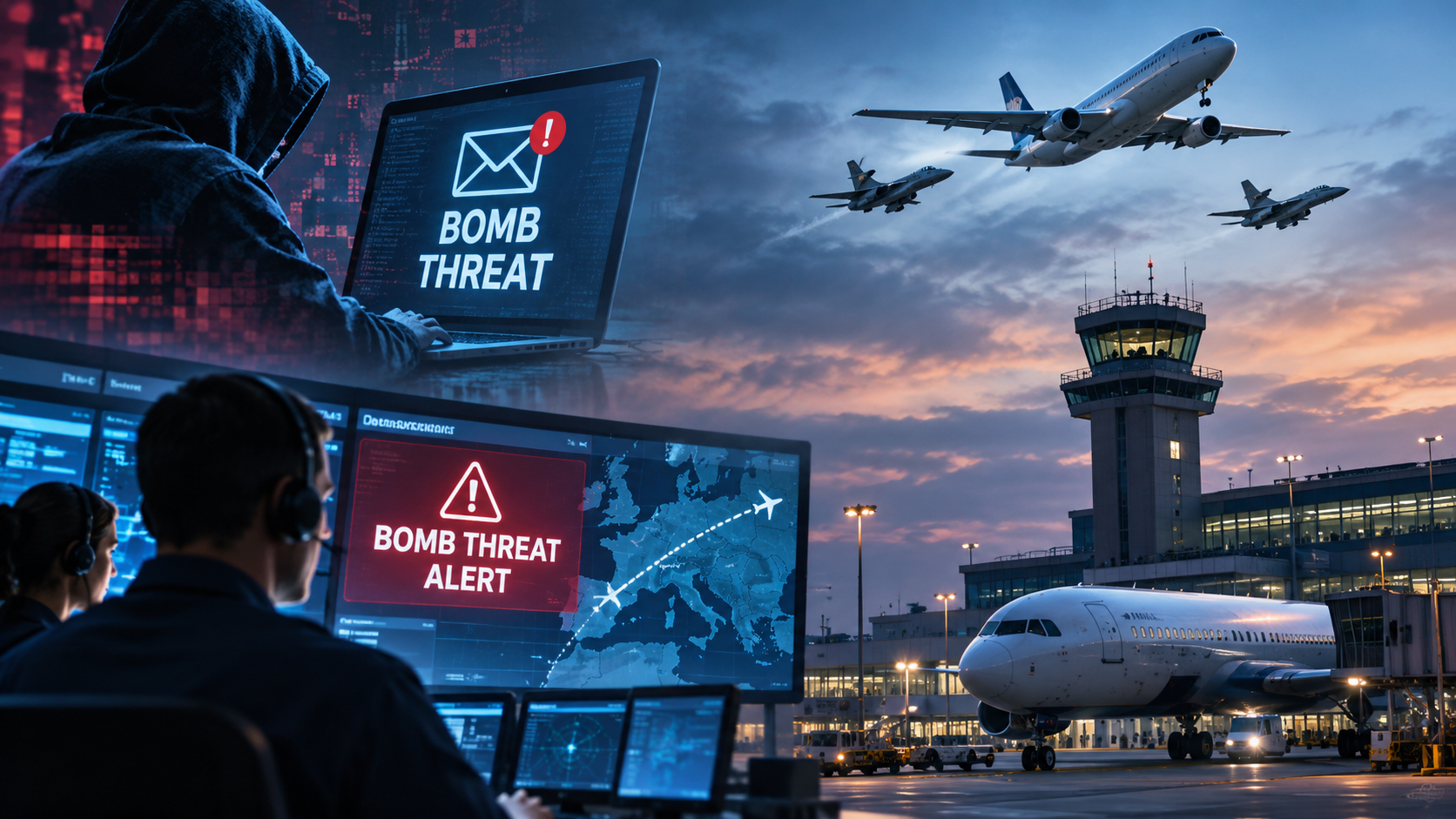
On 5 November, nearly 30 flights across Europe were reported to have been hit by bomb threats, according to Reuters, following earlier waves on Monday and Tuesday. Aircraft were diverted, airports faced disruption and Italian, French and Bulgarian fighter jets were scrambled to escort commercial airliners. Among those diverted was an Aer Lingus flight from Dublin to Rome, which landed at a French air base. No explosives were found, and no government has said who was behind the threats.
The immediate priority was, rightly, to protect passengers and aircraft. Yet the scale and repetition of these incidents raise a wider question: what happens when people deliberately exploit the procedures designed to protect aviation to disrupt it? A bomb threat need not be credible to have real consequences. It can interrupt flight operations, divert security resources, unsettle passengers and impose considerable economic costs on airlines and airports.
We should not advocate creating another layer of aviation security procedures. We should ask whether the existing system is sufficiently intelligent, coordinated and resilient to deal with deliberate attempts to exploit it.
When security procedures become the target
Aviation history shows how difficult it is to assess threats, and what deliberate misinformation can cost.
In December 1988, an anonymous caller contacted the US Embassy in Helsinki warning of an attempt to sabotage a Pan Am aircraft travelling from Frankfurt to the United States. The warning was circulated and subsequently assessed by Finnish police as not credible. Two weeks later, Pan Am Flight 103 exploded over Lockerbie, killing 270 people. There is no established evidence linking the caller to the bombing, and it would be wrong to suggest otherwise. The episode nevertheless illustrates the decisions authorities face when assessing incomplete information about threats whose consequences could be catastrophic.
A more direct example of security procedures being deliberately exploited occurred in May 2021. Ryanair Flight FR4978, travelling from Athens to Vilnius, was diverted to Minsk following a bomb threat communicated by Belarusian air traffic control. No bomb was found. The subsequent ICAO investigation concluded that the threat was deliberately false and had been communicated to the flight crew on the instructions of senior Belarusian government officials. The diversion enabled the arrest of journalist Roman Protasevich, who was on board.
A mechanism designed to protect an aircraft and its passengers had been manipulated to achieve a political objective. The aviation system itself can be used as an instrument of coercion.
The hybrid warfare question
Understandably, the latest incidents have prompted comparisons with hybrid, grey zone or sub-threshold warfare: activities intended to impose costs, create uncertainty or disrupt critical infrastructure without crossing the threshold of conventional armed conflict, often through anonymous actors and deniable methods. Commercial aviation is particularly exposed, because a threat can trigger diversions, emergency inspections and military escorts without any physical attack taking place.
However, recognising the characteristics of an incident is different from establishing who is responsible. An anonymous message, a pattern of disruption or the apparent sophistication of the timing does not, by itself, prove state involvement or a coordinated campaign. Attribution requires evidence, not inference, and the language of hybrid warfare should not become a convenient explanation for every unexplained disruption.
That caution should not lead to complacency. Whether the source is an individual, a criminal network or a state-linked actor, the ability to disrupt essential civilian services through low-cost methods deserves serious attention.
Intelligence, coordination and resilience
If the answer is not another layer of procedures, what should the international aviation community focus on?
- First, intelligence. Authorities need to assess the credibility of threats, identify patterns and distinguish isolated incidents from potentially connected activity. Relevant indicators include how specific a threat is, how it was delivered, whether it resembles earlier hoaxes and whether any corroborating information exists. This means making effective use of information already available across national and institutional boundaries, and keeping suspicion distinct from attribution.
- Second, coordination. Commercial aviation operates across borders, but security responsibilities remain largely national. A threat received in one country may affect an aircraft, airline or destination in another, and the response may involve airport operators, airlines, air navigation service providers, police, intelligence agencies, regulators and, where necessary, military authorities. Existing channels must get relevant information to the right people quickly enough to support operational decisions.
- Third, resilience. Authorities must protect aircraft and passengers while limiting wider disruption: maintaining continuity where possible, restoring normal services, supporting affected passengers and preserving evidence. It also means a proportionate response. Not every threat warrants the same reaction, and credibility assessments, informed by shared information on patterns, should guide how far a response goes. Where credibility cannot be judged, caution must prevail. Resilience is not about taking threats less seriously; it is about ensuring that those issuing them do not dictate how the aviation system functions.
The three depend on one another. Intelligence without coordination has limited operational value, and neither is sufficient if the system cannot absorb disruption and recover from it.
The international framework: Making existing arrangements work
International aviation security has an established framework. ICAO sets global standards through Annex 17 to the Chicago Convention, while States retain responsibility for implementing and enforcing security measures. IATA contributes through operational guidance, training and security information sharing. The 1971 Montreal Convention criminalises communicating information known to be false where it endangers the safety of an aircraft in flight, and provides a basis for international cooperation against such offences.
Within Europe, Commission Regulation (EU) 2026/247, adopted on 2 February 2026, replaces Annex II to Regulation (EC) No 300/2008 and updates the common specifications for national aviation security quality-control programmes. It reflects new ICAO standards on reporting incidents of unlawful interference and on confidential reporting. It requires Member States to establish systems for reporting, classifying, analysing and sharing information on security incidents, acts of unlawful interference and preparatory acts, including a confidential voluntary channel. Its common classification of occurrences expressly includes bomb threats and hoaxes. National authorities must also inform the Commission as soon as possible of events likely to have a serious impact on aviation security in the Union, and the Commission passes that information to the other Member States.
Most of the structured reporting provisions, however, apply only from 1 January 2028, so the harmonised system will not be in place for the current wave of threats. Until then, Europe relies on national procedures and existing cooperation to connect incidents across borders. The priority should be to make those channels work: assess and share the information already collected, improve its quality, preserve digital evidence and pursue cross-border investigations, rather than add new reporting obligations or mechanisms after every incident.
The civil-military dimension also deserves attention. The fighter jet escorts seen during the recent incidents show how a disruption affecting commercial aviation can require military capabilities. Such escorts are precautionary measures, not evidence of an armed attack, but they underline the need for clear responsibilities and effective coordination between civilian aviation authorities and defence organisations. For NATO countries and their partners, the resilience of civilian infrastructure is part of wider national preparedness: aviation supports trade, supply chains and connectivity, and its disruption can have consequences well beyond the airport or airline directly affected.
Protecting aviation without allowing disruption to become the objective
There is a difficult balance to maintain. Every threat must be assessed seriously, but repeated false warnings risk alert fatigue. Security decisions should not be judged solely by what is found afterwards: if an aircraft is searched and no device is found, the response was not necessarily unnecessary, and the system did not necessarily fail. Decisions must be assessed against the information available at the time.
Civil aviation cannot eliminate every threat, and it should not compromise security in pursuit of operational continuity. But it can look beyond individual incidents to emerging patterns and evidence-based attribution, coordinate action across borders and restore normal operations without compromising safety. Aviation security is not simply about protecting aircraft from what may be on board. It is also about protecting the systems, institutions and public confidence on which safe and reliable air transport depends.
If a hoax can repeatedly disrupt the movement of aircraft, occupy security resources and undermine confidence, it has already achieved something. The task is to ensure that those seeking to exploit the system gain no advantage from the very safeguards designed to protect it.
Coordination and cooperation, once again, will go a long way towards ensuring that our skies are not painted red.
