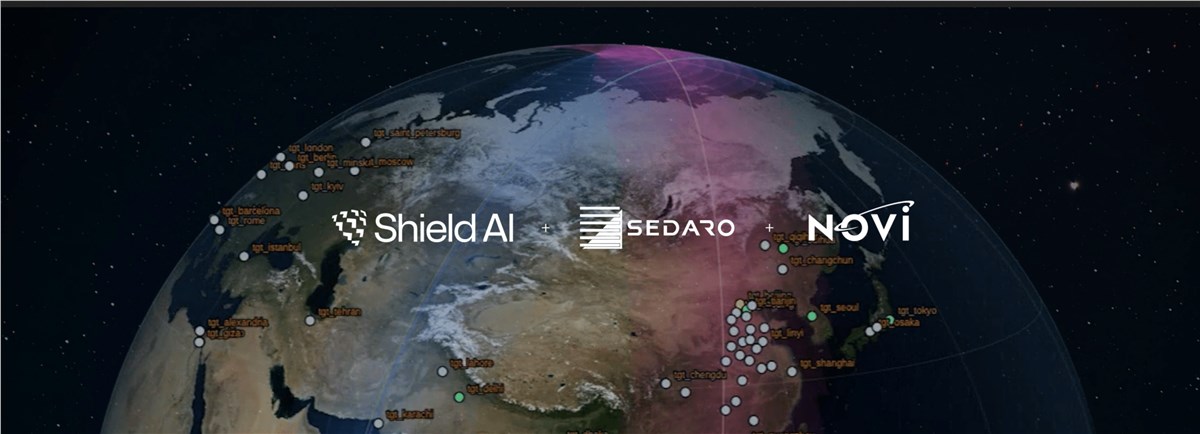
Shield AI, Sedaro, and NOVI Space have announced the successful on-orbit demonstration of trusted satellite autonomy operations facilitated by NOVI operator verification and validation.
Across multiple on-orbit experiments, Shield AI’s Hivemind pilot ran onboard a NOVI satellite in low Earth orbit (LEO) — the first time the AI pilot has flown in orbit. The demonstration represents both the highest-altitude and longest-duration Hivemind deployment to date, extending Shield AI’s autonomy from airborne platforms to an operational satellite in orbit.
With NOVI’s satellite serving as the leader of a six-satellite constellation alongside five virtual satellites, Hivemind, in collaboration with Sedaro’s Autonomy Framework for the Edge (SAFE), performed multi-objective optimisation, balancing imaging tasking, spacecraft health, battery state of charge, and pointing across the constellation. Over a 24-hour experiment window, the spacecraft executed 189 Hivemind-generated and SAFE-approved commands.
In a second experiment, SAFE and Sedaro’s Edge Deployable Simulators (EDS) performed similar multi-objective optimisations and increased the satellite’s Iridium communications contact initiation by 8 percentage points.
Satellite constellations underpin communications, Earth observation, and national security missions, but are still largely managed through manual workflows. This demonstration showed how trusted autonomy capabilities can be layered onto existing and future constellations, significantly reducing operator workload. The exercise also showed that satellites not originally designed for autonomy can successfully orchestrate intelligence, surveillance, and reconnaissance (ISR) missions using Hivemind.
Todd Wesley, Vice President of Hivemind Engineering at Shield AI, stated:
“By integrating Hivemind with Sedaro’s EDS and SAFE framework, we demonstrated how operators can move from manually operating distributed assets to autonomous mission tasking in a seamless workflow. As satellite constellations grow in size and complexity, autonomy will make future space missions more scalable, efficient, and responsive without increasing operator burden.”
Robbie Robertson, CEO and Co-Founder of Sedaro, added:
“The hardest part of autonomous space operations is trust. By providing a predictive, onboard model of the spacecraft and its environment, SAFE and our Edge-Deployable Simulators let operators validate autonomous decisions before they execute.”
Dr. Michael Bartholomeusz, CEO of NOVI Space, commented:
“NOVI’s satellites are built to advance edge computing and AI capabilities on orbit, providing customers with a platform for actual on-orbit testing. We’re proud to support this important technology demonstration.”
Dr. Sean Phillips, Technology Advisor, Space Control Branch, Air Force Research Laboratory, concluded:
“This effort provides a significant milestone to the integration of autonomy and satellite operations to meet future mission needs.”
In late 2025, Shield AI and Sedaro announced a strategic partnership to advance autonomous operations in space, establishing Hivemind as Sedaro’s preferred autonomy software for on-orbit demonstrations and the Sedaro Platform as the primary environment for developing, testing, and validating Hivemind in space-based scenarios. This demonstration marks Hivemind’s first deployment in the space domain.
