

Aurora Flight Sciences, a Boeing company, supports customers developing next-generation vertical flight systems. With more than 30 years of experience in autonomy and rapid prototyping, Aurora provides an end-to-end ecosystem that helps customers reduce technical risk, validate performance, and bring advanced aerospace technologies to market faster.
A Proven Foundation in VTOL Innovation
Aurora’s legacy in vertical flight spans rotorcraft research, vertical takeoff and landing (VTOL) demonstrators, and advanced small unmanned aircraft systems (sUAS). The company has developed a strong understanding of the unique challenges associated with vertical lift, applying that knowledge to structure development efforts around a progressive, risk-reducing test approach. Early testing is conducted in controlled environments, with subsequent phases incrementally increasing complexity and fidelity as systems demonstrate readiness.
GoldenEye: Early VTOL Development
The GoldenEye family of ducted fan VTOL aircraft established Aurora as an innovator in unmanned vertical flight. The GE-100, Aurora’s first VTOL aircraft, first flew in 2003 and served as the foundation for later aircraft. The GE-50, introduced in 2004, explored patented free-wing technology and fully autonomous flight, receiving three experimental airworthiness certificates from the FAA in 2007. The GE-80, first flown in 2005, became the first ducted fan UAV to operate using a heavy fuel engine, advancing propulsion options for compact VTOL systems.
Passenger Air Vehicle (PAV): Urban Air Mobility Prototype
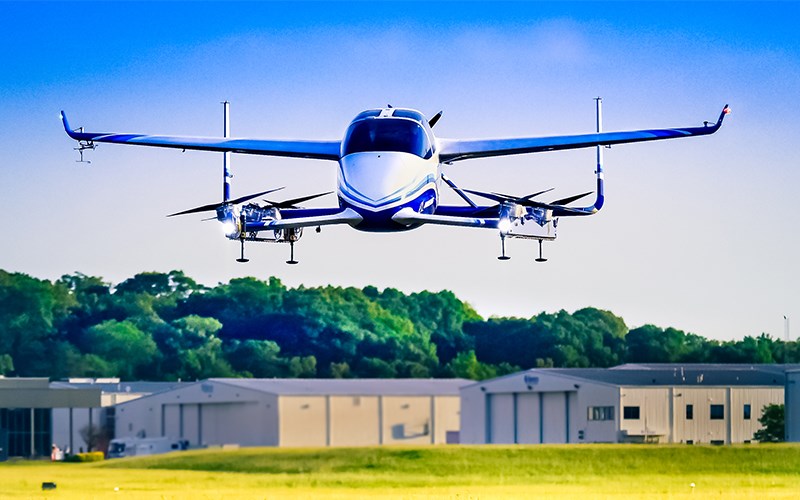
Aurora’s electric VTOL Passenger Air Vehicle first flew in 2019 and contributed to industry efforts in autonomous urban air mobility. Designed for fully autonomous operation, the PAV integrated intelligent flight-management capabilities for each phase of flight, informing requirements and design considerations for future autonomous and electric vertical-lift concepts.
Autonomous Aerial Cargo Utility System (AACUS): Human-Machine Teaming
AACUS was designed to demonstrate how autonomy could support cargo resupply for the U.S. Marine Corps. The system combined radar, LIDAR, and autonomy algorithms to convert a conventional helicopter into a pilotless platform capable of operating in challenging environments. Vehicle-agnostic and requiring minimal operator training, AACUS was initially tested on a Boeing unmanned H-6U Little Bird and a Bell 206. In 2017, Aurora conducted a major demonstration at Marine Corps Base Quantico using a modified UH-1 Huey (AEH-1), completing an autonomous mission that included route selection, obstacle avoidance, landing zone adjustment, and final approach based on simple commands from a handheld tablet.
Simulation and Hardware-in-the-Loop Testing
Aurora’s Hardware-in-the-Loop Simulator (HILSIM) allows engineers to evaluate flight-critical software and hardware in a controlled, high-fidelity environment before aircraft flight, supporting early integration, shortening test campaigns, and reducing flight test risk. The company’s flight simulation lab in Cambridge, Massachusetts supports applied research and prototype development, featuring a reconfigurable environment for autonomy testing and human-machine integration.
Across simulation, UAS testing, surrogate aircraft, and optionally piloted flight, Aurora applies a consistent approach focused on credible data and progressive risk reduction. The company continues to support customers developing advanced VTOL and autonomous aircraft by providing technical expertise, established platforms, and a comprehensive test environment built for system maturation and validation.
