

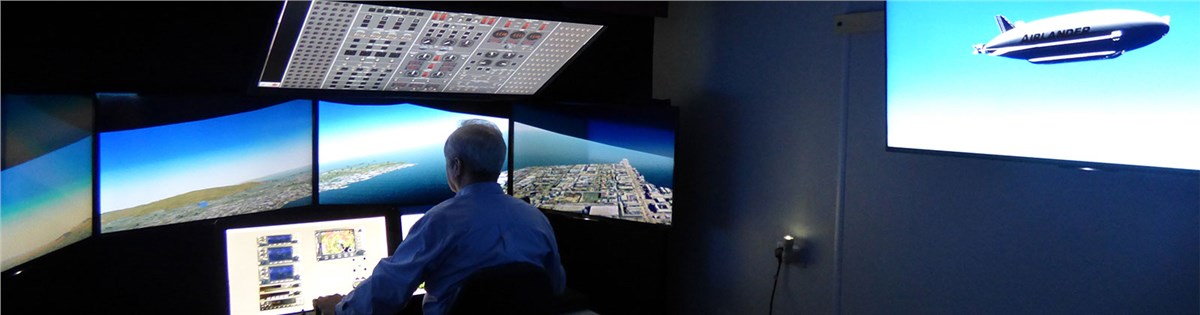
Continuous development followed by thorough testing plays a critical role in the engineering team’s efforts at Hybrid Air Vehicles (HAV) to ensure the Airlander 10 has the best possible design and capabilities as the company works toward Type Certification. Utilizing the Airlander simulator is a core part of this work, enabling the team to test, analyze, and refine the aircraft’s performance in a controlled virtual environment ahead of real-world operations. This has formed a key de-risking phase for the aircraft, proving its operational capabilities.
During the first few months of 2026, HAV’s engineering analysis team conducted several hundred simulated take-offs and landings as part of an ongoing program to refine the aircraft’s performance and operational capability. Over the past year, significant development work has been carried out to optimize the aircraft’s setup and operation. Simulator testing allowed the team to re-baseline performance for take-off and landing run lengths, climb rates, accelerate-stop distances, and go-around capability. This builds on earlier simulator work carried out by the team.
Expanding the Operating Envelope
Alongside updated aircraft configuration testing, the team expanded the scope of simulator testing to include flying the aircraft heavier and lighter than the planned operating envelope, as well as in wind and turbulence levels beyond planned operational limits. The purpose was to ensure the aircraft maintains a safe performance margin at its limits. The team also explored near-vertical take-off limits, where the aircraft relies more on vectored thrust than aerodynamic lift, enabling operation from significantly smaller spaces at reduced payloads.
Key Findings:
- Airlander operates safely beyond its offered flight envelopes for wind and heaviness, confirming strong safety margins without sharp performance limits.
- Go-around trials demonstrated that Airlander can safely discontinue a landing and climb away again, even late in the approach and under demanding conditions, including at maximum heaviness with zero wind.
- At lower heaviness with modest wind, Airlander takes off in such short distances that no near-vertical technique is necessary. Even at maximum payload with zero wind, Airlander requires only 600 metres to take off and climb to 50 feet — comparable to a small aeroplane and less than half the distance required by an airliner with the same passenger capacity.
- Near-vertical take-off using thrust vectoring reduces low-wind take-off distance, enabling safe operations from smaller or more constrained sites.
- Near-vertical landing is practical across a wide range of payloads, enabling landings over obstacles and allowing Airlander to arrive at a safe height, stop using reverse thrust, and land using vectored thrust.
What the Team Says
HAV Test Pilot:
“Five months of very interesting and fun simulator flying has shown that Airlander has a spectacular ability to operate in and out of very small spaces while carrying a commercially useful load. We have shown that Airlander can take off and land safely in strong, turbulent wind conditions, and while that was not so much fun, it was conducted safely and is a vital part of Airlander’s capability.”
