

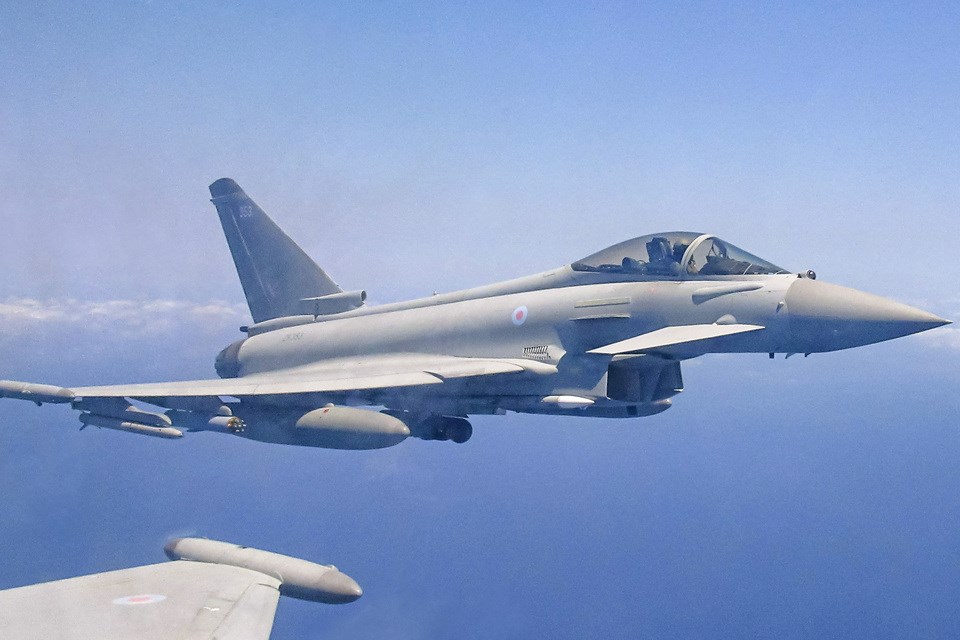
British citizens and regional partners will be better protected against drone attacks as the Royal Air Force deploys a new low-cost anti-drone weapon on operations in the Middle East. The Advanced Precision Kill Weapon System (APKWS) will be fitted to RAF Typhoon fighter jets, enabling them to destroy targets precisely at a fraction of the price of missiles currently used.
Rapid procurement and testing work by the Ministry of Defence and industry partners BAE Systems and QinetiQ has enabled the system to move from testing to operational deployment in less than two months. March saw a successful test strike on a ground-based target, and RAF Typhoon pilots from 41 Test and Evaluation Squadron conducted successful air-to-air firing in April, demonstrating the system’s ability to defend against drone attacks.
The system has now been deployed on operations in the Middle East, with sorties flown by 9 Squadron RAF Typhoon fighter jets as part of missions to defend British people, interests, and partners from threats.
Minister for Defence Readiness and Industry Luke Pollard MP stated:
“This has been a superb effort working with industry to test and deploy this system in a matter of months, which will help the RAF shoot down many more drones at a much lower cost. Our Typhoon fleet is the backbone of UK and NATO air defence, with the RAF protecting Europe’s eastern flank from Russian drone incursions and defending our partners across the Middle East.”
The APKWS uses a laser targeting system that turns unguided missiles into low-cost precision weapons capable of taking down enemy drones and other threats. Developing low-cost systems provides a more effective and sustainable means of countering the increasing threat of drones to UK forces and partners.
Simon Barnes, Group Managing Director of BAE Systems Air sector, added:
“Our priority is to ensure the Royal Air Force and its allies have the advanced technologies they need today and into the future to keep them ahead of evolving threats. This capability demonstrates Typhoon’s exceptional versatility and underlines its continued role as the backbone of combat air across Europe and the Middle East.”
Steve Wadey, Group Chief Executive Officer of QinetiQ, concluded:
“From engineering expertise to live trials, our teams are providing the fundamental support needed by our armed forces to deliver the urgent capabilities that ensure the UK and its allies remain safe and warfighting ready.”
Air Commodore Donal McGurk, Air 11 Group Deputy Director Operations, commented:
“We welcome the speed of development and meticulous testing behind the deployment of these missile systems for use on our Typhoons. They are a valuable addition to the air defence package we are already employing with agility across the Middle East.”
UK aircraft continue to operate across the Middle East, with pilots and aircrew having surpassed 2,500 flying hours since the conflict in the region began — equivalent to over three months of continuous flying on defensive missions.
