

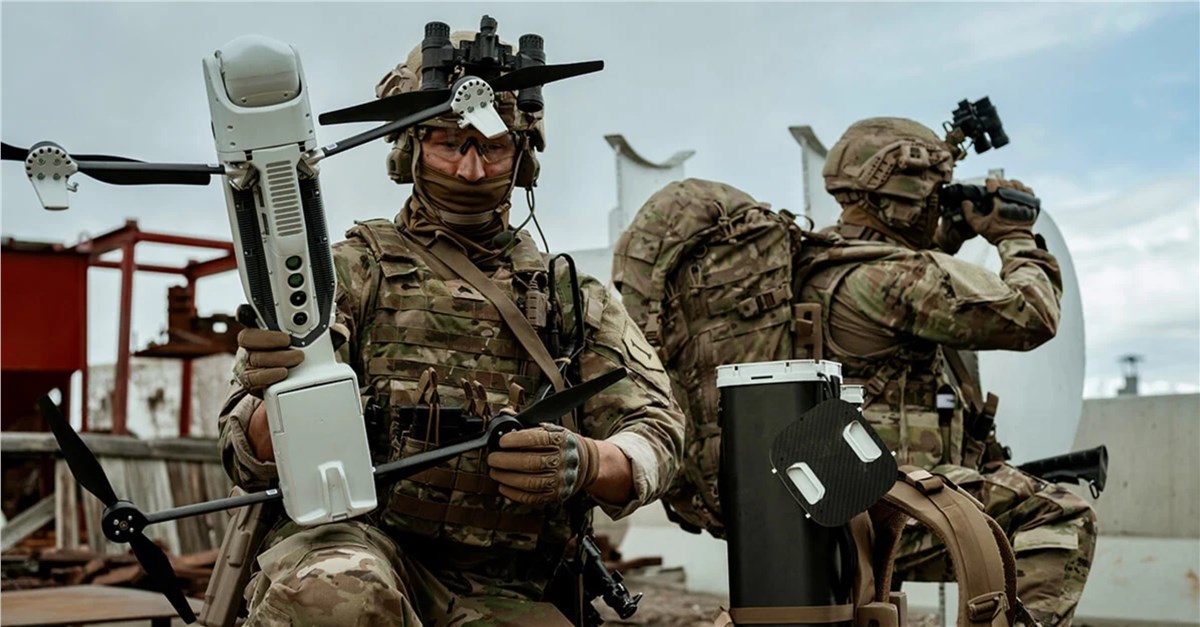
Teledyne FLIR Defense, part of Teledyne Technologies Incorporated, has announced that its Rogue 1 loitering munition system has been selected by the U.S. Army for the Low Altitude Stalking and Strike Ordnance (LASSO) program.
Teledyne FLIR will deliver a variant of its Rogue 1 lethal unmanned aerial system (UAS) for LASSO. Launched in spring 2024, the U.S.-designed and built Rogue 1 has already been delivered to both U.S. Special Operations Command (Ground Organic Precision Strike Systems) and the U.S. Marine Corps (Organic Precision Fires-Light) for their current loitering munition programs.
As described in Army solicitation statements, the LASSO system is a man-portable, ground-launched, lethal payload munition and uncrewed aerial system with anti-armor capability for use by Infantry Brigade Combat Teams. LASSO is designed to deliver long-range precision strike fire with minimal collateral damage in complex environments.
Dr. JihFen Lei, President of Teledyne FLIR Defense and Senior Vice President of Teledyne’s Defense and Aerospace Group, stated:
“The precision and autonomy of the Rogue 1 platform make it ideally suited to achieve the Army’s goals for LASSO. Rogue 1 leverages our expertise delivering battle-proven UAS technology, including the widely deployed Black Hornet nano-drone, which we believe can be used with Rogue 1 in an unrivaled ‘hunter-killer’ combination. We will continue to work closely with the Army to help combat teams improve their mobility and lethality and achieve tactical overmatch against our adversaries.”
Rogue 1 is a next-generation, optionally recoverable vertical takeoff and landing (VTOL) UAS that enables warfighters to conduct precision strikes against moving and stationary armored targets, soft-skinned vehicles, and dismounted threats. The Rogue 1 system is light enough to be carried by a single soldier in a single tube and does not require vehicle transport nor a launcher — key features for Infantry forces.
Other features include advanced electro-optical and FLIR Boson 640+ thermal cameras to deliver day/night long-range reconnaissance and surveillance. A novel coupling between sensors and warhead in its gimballed payload enables extremely precise targeting. With a greater than 30-minute flight time, burst speeds exceeding 70 miles per hour (113 kilometers per hour), and a range of more than 12 miles (20 kilometers), Rogue 1 was designed for today’s harsh battlefield conditions, including communication- and GPS-denied environments.
Teledyne FLIR will deliver up to 130 Rogue 1 components and systems to the Army for test and evaluation next summer. The contract has a two-year performance period.
