

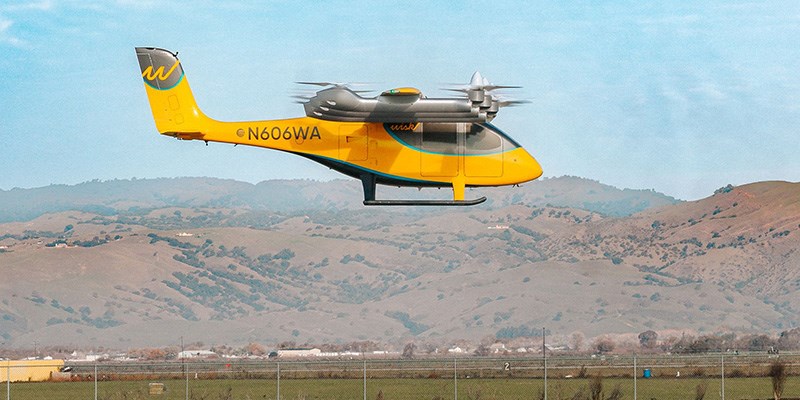
Aurora Flight Sciences, a Boeing company, provided engineering expertise to support the design of Wisk’s Generation 6 aircraft, which recently completed its first flight. Wisk’s Gen 6 is the first-ever candidate for an FAA-certified commercial autonomous passenger aircraft. Aurora’s contributions supported the program’s demanding safety and performance goals.
Clint Church, Aurora’s interim president and CEO, emphasized the broader significance of the accomplishment. “The first flight is the culmination of years of collaboration with Wisk to design and build the Generation 6 aircraft. It’s a testament to the team’s collective expertise and it lays the groundwork for certification of the world’s first all-electric, autonomous 4-seat air taxi.”
During the test, the aircraft performed vertical takeoff, hover, and stabilized flight maneuvers, validating its core flight systems. Aurora engineers supported battery development and testing; aircraft design; subsystem integration; guidance, navigation and control (GNC) systems; and materials processing for the test aircraft.
Energy Storage
One of Aurora’s key responsibilities included validating the performance and safety of the battery system that powers the aircraft’s electric propulsion. Aurora engineers conducted rigorous evaluations to make sure the batteries could store enough energy, handle heat safely, and keep wiring intact during stress. These tests were critical to confirm that the aircraft could deliver consistent power while mitigating risk, a top priority for electric propulsion systems.
Stability and Control
Aurora also played a major role in shaping the aircraft’s aerodynamic stability and control. Hovering may appear simple, but it demands precise balance and responsiveness. Aurora’s flight physics team helped fine-tune the aerodynamics and control systems to keep the aircraft steady during the flight. This capability is essential for operational reliability and sets the stage for more complex autonomous maneuvers.
Aurora’s expertise in GNC provided the precision needed for the aircraft to safely fly and land without an onboard pilot. Aurora integrated critical computing subsystems, creating seamless communication between hardware and software components.
Structural Integrity
Aurora’s materials, processes, and testing (MPT) team provided expertise to make the Gen 6 aircraft strong, safe, and ready for flight. The team ran engineering tests to confirm bonding strength, surface preparation methods, and lightning strike protection, ensuring the aircraft could withstand real-world conditions.
Today, Aurora continues to work with Wisk to execute its flight test program, which is focused on validating the design, simulation models, and performance of the Gen 6 aircraft.
