

By Sagar Singamsetty, EDITOR @EDI
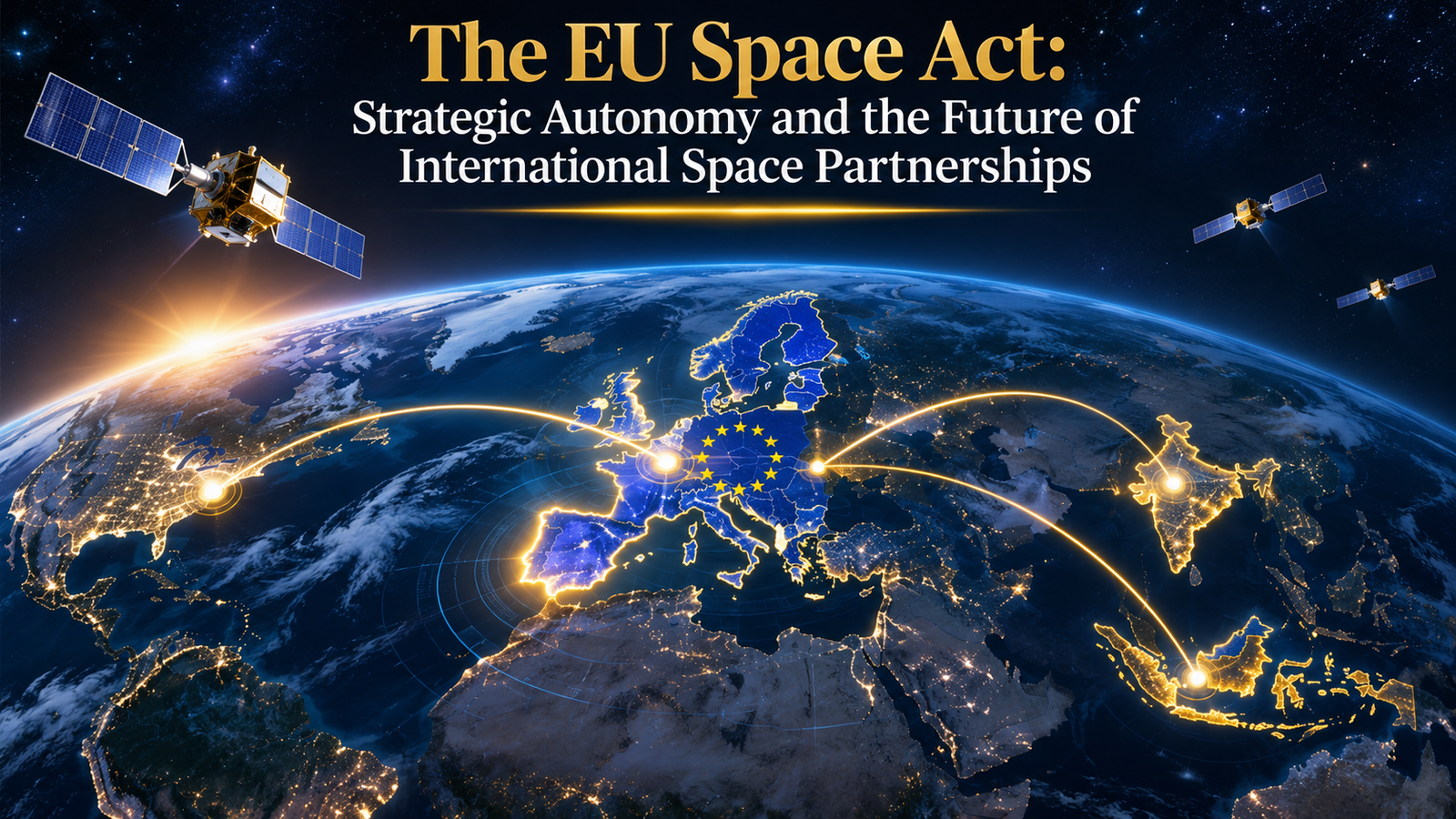
As Europe moves towards a common regulatory framework for space activities, a critical question is emerging: will the EU Space Act strengthen Europe’s position in the global space economy while supporting the international partnerships it is seeking to develop?
A new regulatory milestone for Europe
The European Union’s ambition to establish a common regulatory framework for space activities reached an important milestone on 19 November 2026, when the European Parliament’s Committee on Industry, Research and Energy (ITRE) adopted its report on the proposed EU Space Act by 72 votes to one, with two abstentions. The committee also endorsed a mandate to open negotiations with the European Council, which must first be announced in plenary. The Act has not yet been adopted, and the text will still be negotiated with the European Council and the European Commission (Trilogue).
The proposal seeks to address fragmentation in national regulatory approaches and establish common requirements covering space safety, resilience and environmental sustainability. For European companies, this could provide greater legal certainty, facilitate cross-border operations and support a more integrated European space market.
The ITRE report, led by Rapporteur Elena Donazzan, also seeks to make the framework more proportionate to industry needs, including lighter requirements for smaller companies, streamlined authorisation procedures and the removal of certain duplicative obligations. It also proposes bringing the space sector within the scope of the NIS2 cybersecurity directive and creating a helpdesk for smaller actors at the EU Agency for the Space Programme.
However, the significance of the EU Space Act extends beyond harmonising European rules. It raises a broader question about how Europe can strengthen its strategic autonomy while remaining connected to an increasingly international space economy.
International partnerships need regulatory support
The EU is simultaneously pursuing closer economic and strategic relationships with countries across different regions. The conclusion of negotiations on the EU–India Free Trade Agreement in January 2026 and the signing of the EU–Indonesia Comprehensive Economic Partnership Agreement and Investment Protection Agreement in November 2026 illustrate Europe’s expanding engagement with the Indo-Pacific. Its longstanding relationship with the United States provides another important dimension, particularly in space technology, research, commercial services and security.
These partnerships create opportunities for investment, industrial cooperation, technology development and more resilient supply chains. However, political and economic agreements do not automatically translate into sector-specific market access.
A free trade agreement may facilitate trade and investment, but it does not necessarily resolve the licensing, authorisation, certification, cybersecurity or security requirements that a satellite operator or space technology company must satisfy to operate in another jurisdiction.
This is where the EU Space Act becomes particularly important.
There is a need to connect horizontal economic partnerships with vertical regulatory cooperation. In practical terms, this means developing mechanisms through which different national regulatory systems can recognise comparable outcomes, facilitate market access and support cross-border industrial cooperation.
Without such mechanisms, the ambitions expressed through broader trade and strategic partnerships may not translate into meaningful opportunities for the space industry.
Equivalence and reciprocity: The international dimension
One of the most consequential aspects of the proposed legislation concerns operators established outside the European Union.
The ITRE report places greater emphasis on reciprocity and equivalent treatment and seeks to tighten the rules on equivalence decisions. The European Council Presidency’s compromise text of 29 October 2026 retains and builds on a route, first introduced as Article 17a under the Cyprus Presidency, for recognising third-country regulatory frameworks through EU equivalence decisions.
This is an important opportunity. Recognition of comparable regulatory outcomes could reduce unnecessary duplication and provide international operators with a more predictable route into the European market.
However, equivalence should not necessarily require identical legislation or institutional structures. Different jurisdictions have different regulatory traditions and national priorities. The relevant question should be whether their frameworks achieve comparable outcomes, provide effective supervision and address legitimate safety and security concerns.
For emerging space economies such as India and Indonesia, the transparency of assessment criteria, predictability of procedures and availability of meaningful recognition arrangements will be particularly important. European companies should also benefit from comparable opportunities in partner markets if reciprocity is to become a meaningful basis for cooperation.
Industry has already begun to respond. On 23 November 2026, the day of the ITRE vote, space industry associations from the United States, India and Indonesia issued a joint statement, coordinated by GraySpace Consulting, calling for a balanced approach as the European policymakers move into the next stage of negotiations. The associations accept the legitimacy of reciprocity and of a level playing field for European operators, but ask that “equivalence be assessed through transparent, objective and proportionate criteria that recognise comparable regulatory outcomes rather than identical legal frameworks. They also call for the avoidance of unnecessary duplication and disproportionate requirements for international operators, and for an open, predictable and non-discriminatory environment for responsible international cooperation and investment”.
The effectiveness of this mechanism will ultimately depend on how the European Parliament and European Council reconcile their positions, and on whether the final text facilitates genuine regulatory cooperation rather than creating another layer of market-access requirements.

The US example: A warning against regulatory fragmentation
Developments in the United States provide an interesting illustration of the wider implications.
On 23 November 2026, US Federal Communications Commission (FCC) Chairman Brendan Carr announced that the Commission would vote in December on a proposal concerning foreign satellite operators accessing the US market. The proposed approach would apply to foreign providers the same restrictions their home jurisdictions impose on American satellite operators.
The FCC explicitly referred to the EU Space Act and the Digital Networks Act when explaining its concerns about reciprocity, as it had in a public consultation launched in March 2026. It also highlighted the proposed changes to the EU authorisation framework for Mobile Satellite Services in the 2 GHz band. The US Ambassador to the EU had also criticised the Space Act, days before the ITRE vote.
The proposal has not yet been adopted. Nevertheless, it illustrates how sector-specific regulatory decisions can influence relationships between major space markets, even where longstanding commercial and technological partnerships already exist.
There is an important distinction between recognising equivalent regulatory outcomes and responding to restrictions through reciprocal measures. The former can facilitate cooperation between different regulatory systems; the latter, if applied broadly, could encourage a cycle of restrictions, increasing uncertainty and costs for international operators.
For Europe, the challenge is to ensure that its regulatory ambitions do not inadvertently undermine the international cooperation that its wider economic and strategic policies seek to encourage.
The real test of Europe’s Space Act
The EU Space Act should be viewed not only as an instrument for harmonising regulation within Europe, but also as an opportunity to establish a framework for international regulatory cooperation.
This requires transparent equivalence criteria, structured engagement between regulatory authorities, predictable market-access arrangements and recognition of comparable safeguards. It also requires greater coordination between the EU’s trade, technology, industrial and space policies.
Europe has legitimate reasons to strengthen its technological sovereignty, protect critical infrastructure and develop its domestic capabilities. However, strategic autonomy does not necessarily mean regulatory isolation or self-sufficiency. Europe’s competitiveness also depends on access to international markets, investment, technology, talent and trusted supply chains.
The success of the EU Space Act should therefore be measured not only by the extent of regulatory harmonisation, but also by whether it enables European companies to compete internationally and supports meaningful partnerships with trusted spacefaring nations.
Europe’s strategic autonomy will be strengthened not only by the rules it establishes, but also by the international partnerships those rules make possible.
