

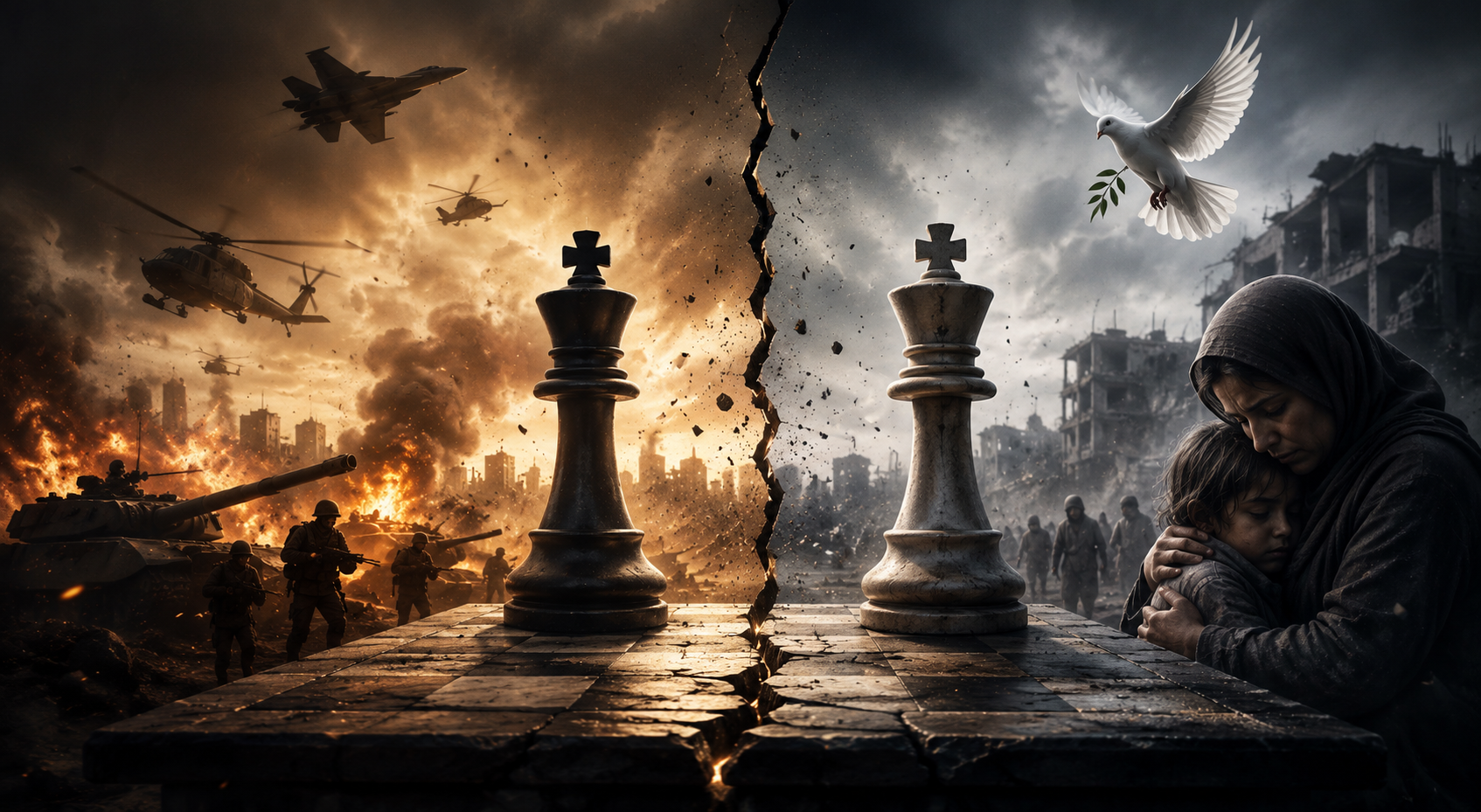
The character of conflict has changed. Has the defence sector kept up?
For most of recorded history, States chose their wars. They weighed the costs, built alliances, issued ultimatums and then committed their forces with clear objectives in mind. That luxury is gone. The conflicts reshaping our world today were not chosen by the nations bearing their costs. They were imposed. And a defence sector built for an era of deliberation is now struggling to keep pace with an era of compulsion.
When War Was Something You Decided
Think about how wars used to begin. A king wanted territory. A government calculated that its adversary was weak. A general staff war-gamed the logistics and gave its leaders a timeline for victory. War, for most of recorded history, was something that powerful actors chose to do, and the decision to start one was also a decision about how it would be fought and on what terms it might end. Carl von Clausewitz, writing in the early nineteenth century, gave this reality its most enduring formulation: war is the continuation of politics by other means. It was not a justification for violence. It was a description of how States actually behaved. And for roughly two hundred years, from the Napoleonic Wars through two World Wars and across the Cold War, that description remained largely accurate.
The numbers alone tell you how seriously the States once committed to the wars they chose. The United States spent roughly $4.1 trillion in today’s money fighting the Second World War, mobilising 12 million men and women in uniform and converting its entire industrial economy to wartime production virtually overnight. Britain spent the equivalent of 55 percent of its GDP on the war effort in 1943 and 1944. These were societies that understood, viscerally, what it meant to be at war, and they organised themselves accordingly.
The post-Cold War decade produced a different kind of commitment. When the United States and its allies intervened in Bosnia, Kosovo, Iraq and Afghanistan, these were wars of choice. Expensive and sometimes catastrophic choices, but choices. The US Department of Defence estimates total spending on the post 9/11 wars at over $8 trillion when long-term veteran care and interest on war borrowing are included. Western militaries could still set the terms, select the battlespace, and largely determine when and how they would fight. That era ended somewhere between Russia – Georgia in 2008 and the Russia-Ukraine war in 2022.
“The post-9/11 wars cost the United States over $8 trillion. The wars now being fought across Europe’s eastern flank are costing something harder to price: the assumption that peace on this continent was permanent.”
What Changed, and Why It Matters
The intervening years brought something that strategists struggled to name and institutions struggled to govern: the normalisation of conflict that sits below the formal threshold of war. Proxy forces, infrastructure sabotage, disinformation campaigns, and economic coercion. Adversaries learned, systematically, that the rules-based international order could be exploited. Nuclear weapons provided escalation cover. Plausible deniability neutralised collective defence mechanisms. And when it came to responding, Western governments consistently chose the path of least political resistance. A decisive response meant difficult conversations with the public about war, about spending, about risk. Ambiguity meant deferring those conversations. So they deferred them. The problem was that adversaries read that hesitation as permission to keep going.
The result is a world where the boundary between war and peace has effectively ceased to exist. Baltic undersea cable cuts, GPS spoofing over the Eastern Mediterranean, coordinated election interference, Houthi drone campaigns against global shipping. None of these cross the legal threshold for armed attack under Article 51 of the UN Charter, yet all impose strategic costs comparable to conventional military action. The Houthi campaign against Red Sea shipping has reduced traffic through the Bab el Mandeb by over 60 percent from 2023 levels and added an estimated $15 to $20 billion annually to global supply chain costs. A Yemeni militia, the Houthis, demonstrated that you no longer need to be a nation-state to cause damage at a strategic scale. They held one of the world’s most critical trade routes to ransom using weapons that cost a fraction of what it took to counter them. That is not an accident of geography. It is a deliberate demonstration of what the new warfare looks like.
Technology has been the great accelerant. Cheap drone systems have put capabilities in the hands of middle powers and non-State actors that were once the exclusive preserve of advanced air forces. Ukraine has shown that a combination of commercial innovation, adaptive tactics and Western precision systems can blunt a conventional armoured assault. But it has also shown that the relevant technology cycle is now measured in weeks rather than years. A drone variant that dominates the battlefield in January can be countered and obsolete by March.
Artificial intelligence and space-based infrastructure are becoming the nervous system of modern warfare. Satellite constellations now shape battlefield awareness, navigation, communications and targeting in real time, while AI-enabled systems increasingly influence decision-making cycles, logistics, cyber defence and autonomous operations. The strategic competition unfolding today is therefore not only about military hardware, but also about data dominance, computational capacity and control over critical digital infrastructure.
And then there is the economic dimension, which may matter more than any of the military factors. Russia’s weaponisation of energy forced Europe into a structural reorganisation of its supply chains at a cost running into hundreds of billions of euros. Chinese dominance in rare earth minerals, battery technology and semiconductor manufacturing gives Beijing leverage points across virtually every advanced defence system in the Western arsenal. The old saying that ‘militaries win battles but economies win wars’ has never been more literally true, or more uncomfortable to sit with.
“A drone variant that dominates the battlefield in January can be countered and obsolete by March. Legacy procurement cycles of ten to fifteen years are not a bottleneck. They are a strategic liability.”
Is the Defence Sector Actually Ready?
The honest answer is: partially, and unevenly. European defence spending has increased substantially since 2022, with 23 of 32 NATO members now at or above the 2 percent of GDP benchmark. That sounds like progress, and in some ways it is. But consider what it took to get there. Russia had to launch the largest land war in Europe since 1945, sustaining estimated losses of over 600,000 casualties by early 2026, before European governments found the political will to fund the capabilities their own analysts had been recommending for years.
The structural gaps are large and they are honest. European ammunition stocks remain critically depleted despite three years of public warnings. The defence industrial base, despite decades of consolidation, remains fundamentally configured for small-batch, nationally procured, high-specification systems. That is the exact opposite of what modern warfare demands: high volume, rapid iteration, and the ability to surge production rapidly when the situation changes. Germany’s Rheinmetall, one of Europe’s largest defence manufacturers, has been working at maximum capacity since 2022 and still cannot fill the artillery shell orders on its books. That is not a criticism of the company. It is a structural fact about an industry that was optimised for a world that no longer exists.
The deeper problem goes beyond ammunition and production rates. The wars being fought today cost money in ways that are genuinely new. Ukraine’s defence budget for 2025 was approximately $67 billion, around 26 percent of the country’s entire GDP, with the majority of that covered by external donors, including the European Union and the United States. The ongoing conflict is estimated to have destroyed over $500 billion in physical infrastructure inside Ukraine since February 2022. Rebuilding that, even after a ceasefire, will take a generation and cost more than the annual GDP of most European member states. The financial arithmetic of modern warfare, where the cost of destruction vastly outpaces the cost of the weapons doing the destroying, fundamentally changes the calculus of deterrence.
“The cost of a single Russian glide bomb is roughly $30,000. The apartment block it destroyed costs $3 million to rebuild. Modern warfare has industrialised the economics of ruin.”
The Only Scenario Worth Planning For
Europe is not without options. But the window for comfortable incrementalism is closing. The choice is increasingly binary: either make the structural transformation that the threat environment demands, integrating defence industrial policy with energy, trade and technology strategy around a coherent strategic framework, or continue spending more on a system that remains configured for yesterday’s wars while adversaries exploit the distance between Europe’s rhetoric and its actual capability.
The transition from wars of choice to wars of necessity was not sudden. It was the cumulative result of strategic complacency, institutional inertia and a persistent failure to take adversarial signalling seriously when it was cheaper and easier to do so. Europe is paying that bill now, in treasure, in the exhaustion of Ukrainian soldiers and civilians, and in the accelerating erosion of the security framework that underwrote the continent’s prosperity since 1945.
The defence sector cannot settle that debt alone. But it cannot be settled without it. Mobilising industrial, economic and military capacity for security is no longer an emergency measure to be triggered when the shooting starts. It is the permanent condition of a continent that has chosen, belatedly but seriously, to defend the world it wants to live in.
“Militaries win battles. Economies win wars. But only societies that understand they are in one, and organise themselves accordingly, will shape the peace that follows.”
The defining question for Europe is no longer whether conflict can be avoided entirely, but whether democratic societies can adapt faster than the threats reshaping the world around them.