

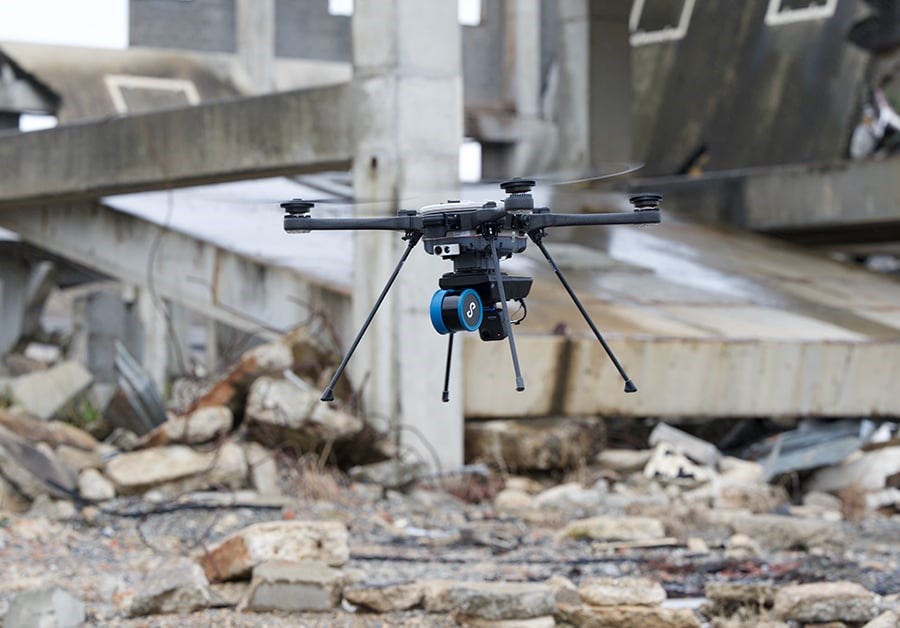
Teledyne FLIR Defense has announced the expansion of its Third-Party Payload Integration Program with the certification of Emesent’s Hovermap LiDAR Payload. The agreement will deliver Emesent’s GPS-denied 3D-mapping capabilities across Teledyne FLIR’s unmanned aerial systems, ground robots, and radiation detection platforms.
The Emesent–Teledyne FLIR combination addresses a GPS-denial gap in air and ground domains where unmanned systems can lose GPS connectivity in common operating areas, such as tunnels, urban structures, and CBRN-contaminated spaces. Using LiDAR-based simultaneous localization and mapping, Emesent’s Hovermap payload generates accurate 3D maps without GPS or external infrastructure.
On Teledyne FLIR’s SkyRanger R70 and R80D SkyRaider UAS platforms, Hovermap enables mapping even in GPS-denied environments. Mounted on the company’s SUGV 325 ground robot, Hovermap provides users with persistent 3D awareness of complex enclosed environments streamed in real time. Integrated with Teledyne FLIR’s MUVE R430 radiation detection payload on the SUGV, Hovermap allows operators to see not just where a robot has been, but where radiation levels are elevated, giving CBRN teams an immediate, geo-referenced picture of the threat environment.
“Knowing the shape of a space is powerful. Knowing where the radiation is within that space, in real time, without putting a person in harm’s way, is an operational game-changer,” said Stefan Hrabar, co-founder and chief strategy officer at Emesent. “Our partnership with Teledyne FLIR Defense brings together GPS-denied mapping and radiation detection in a way that directly addresses what CBRN operators need in the field.”
“Teledyne FLIR builds platforms trusted for the most demanding CBRN missions in the world,” said Tung Ng, vice president of Unmanned Systems North America for Teledyne FLIR Defense. “Working with Emesent, we will be able to give operators a fused, spatial picture of the threat environment they simply have not had access to before. This is the direction the whole field is heading in, and we are delivering it now through certified third-party payloads like Hovermap.”
Emesent’s Hovermap represents the firm’s success in utilizing Teledyne FLIR Defense’s open-architecture, partner-enabled development ecosystem. Certified payloads are assessed for mechanical fit, electrical interface, software compatibility, and flight performance, giving customers confidence in mission-tailored capabilities from a growing partner ecosystem. The partnership also establishes a technical foundation for future capability development. Both companies are actively developing autonomous navigation capabilities and expanding multi-sensor fusion beyond radiation to additional CBRN detection modalities.
