

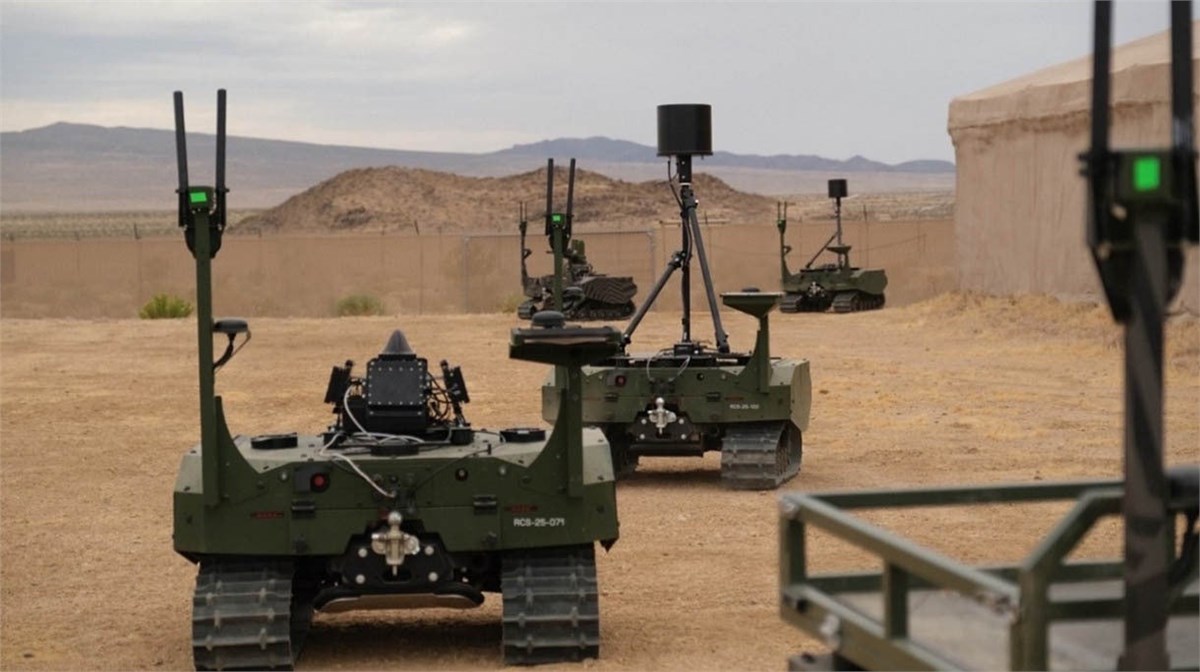
L3Harris and ARX Robotics UK have demonstrated the integration of the CORVUS-RAVEN passive counter-drone sensor onto the GEREON uncrewed ground vehicle during Project Convergence-Capstone 6. CORVUS-RAVEN passively detects signals associated with potential drone threats and provides bearing information to improve operator situational awareness.
Mounted directly on the ARX platform, the capability demonstrated how a remotely controlled uncrewed ground vehicle could carry the sensor into forward areas and share threat information with operators elsewhere in the battlespace.
Nicky Tabram, Managing Director of Global Spectrum Superiority UK at L3Harris, stated:
“Our collaboration with ARX Robotics UK demonstrated the value of combining proven mission capabilities with innovative robotic technologies from across the defense ecosystem. By mounting CORVUS-RAVEN on a remotely controlled uncrewed ground vehicle, we explored how operators could extend passive sensing into forward or hazardous areas, enhance situational awareness, and reduce personnel exposure.”
The integration brought together two complementary technologies: an adaptable counter-drone capability designed to provide passive detection and situational awareness with a modular robotic platform capable of transporting mission payloads.
David Roberts, CEO of ARX Robotics UK, added: “Project Convergence has allowed us to demonstrate how uncrewed ground systems can extend the reach of specialist capabilities without extending the risk to personnel. Integrating CORVUS-RAVEN with the GEREON shows how passive and active electronic warfare can be moved closer to the threat while keeping operators at a safer distance.”
Small uncrewed aircraft can approach from multiple directions at low altitude, presenting threats across wide areas. Countering those threats requires sensors that can be positioned where needed and adapted as the operational environment changes. Integrating CORVUS-RAVEN onto a remotely controlled uncrewed ground vehicle offers a way to move passive sensing closer to likely threat approaches and reposition the capability as mission requirements evolve.
The effort also demonstrated the flexibility of the CORVUS-RAVEN system. Built on open architecture, the capability can generate TAK-compatible messages and support integration with command-and-control applications, allowing threat-bearing information to contribute to a shared geospatial operating picture.
The L3Harris-ARX demonstration showed how modular hardware and open architectures can reduce integration barriers and enable complementary technologies to be combined more quickly. It also provided insight into how counter-drone and uncrewed ground systems could work together to support dispersed formations and future operational concepts.
