

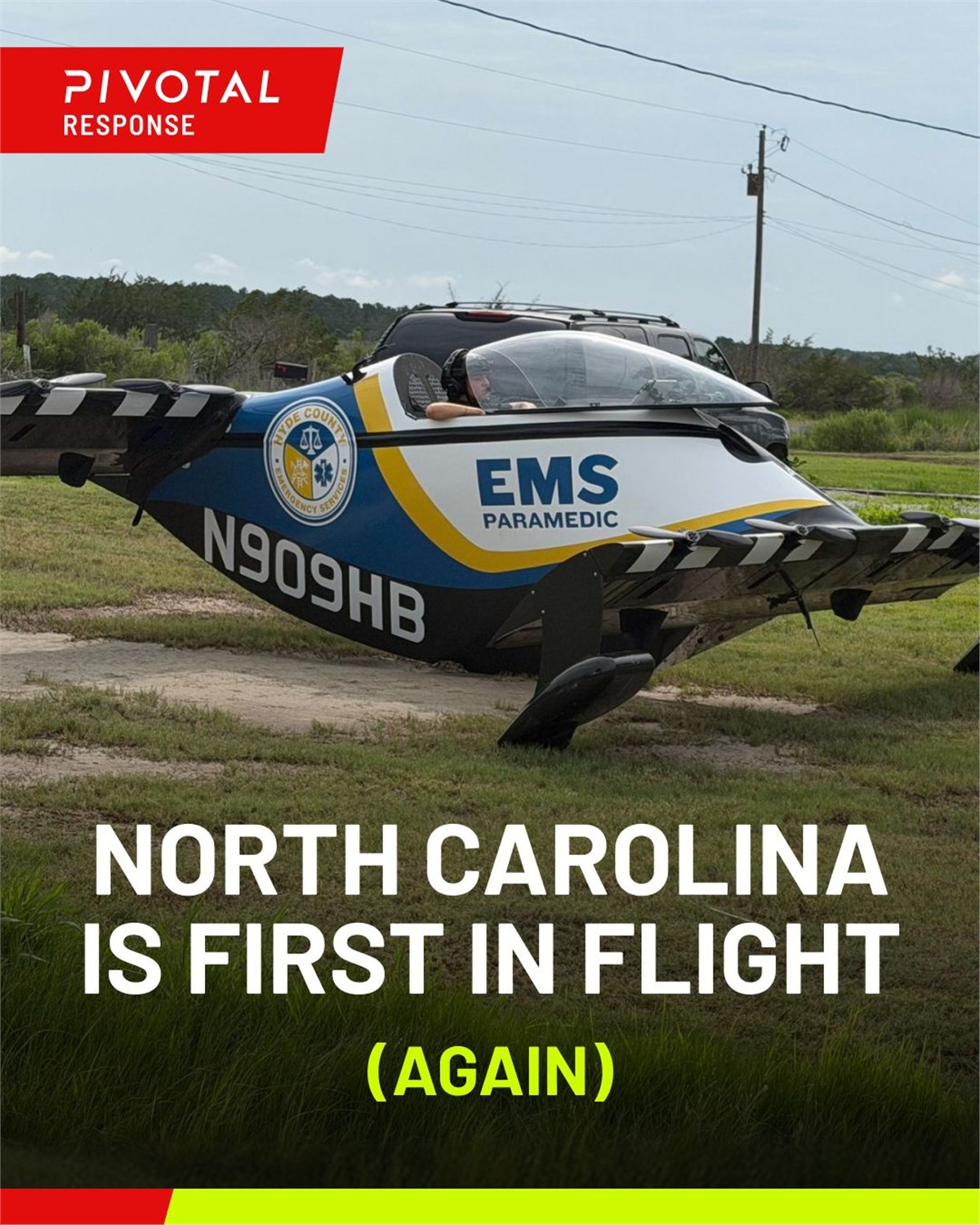
Hyde County Emergency Medical Services, Code Blue Resources and Pivotal® announced a national first that could reshape emergency medical response in rural America. During two live 911 emergency calls, a flight-trained paramedic piloted an electric vertical takeoff and landing (eVTOL) aircraft directly to patients, one call arriving approximately 20 minutes before ground the ambulance and beginning Advanced Life Support (ALS) while crews were still en route.
The operational missions mark the first deployment of an eVTOL aircraft as part of routine emergency medical response in the United States. By dramatically reducing the “First-to-Patient” interval—the critical time between dispatch and the arrival of advanced medical care—the program demonstrates a new model for delivering lifesaving treatment in geographically challenging communities where every minute can influence patient outcomes.
Months of planning, in-depth flight training and operational preparation preceded the milestones. Hyde County EMS, Code Blue Resources and Pivotal developed the nation’s first concept of operations (CONOPS) for integrating eVTOL aircraft into emergency medical response, completing more than 300 training sorties before launching live missions under Public Aircraft Operations. Akute Networks, serving as Aviation Program Manager, worked with the partners to develop the operational framework, protocols and flight procedures that made the historic missions possible.
“Every decision we make is about getting advanced care to our citizens faster,” said Hyde County EMS Chief Brook Cox. “These missions proved that we can overcome distance, reach patients sooner, and redefine emergency response in rural communities.”
Hyde County spans nearly 1,500 square miles of land and water, making it one of North Carolina’s largest and most geographically challenging EMS response areas.
“From the beginning, our goal wasn’t simply to prove an eVTOL could respond to a 911 call—it was to prove that Advanced Life Support could reach patients sooner,” said Carla Baker, President of Code Blue Resources. “This project demonstrated far more than the successful integration of aviation into EMS. It validated a new model for emergency response—one where experienced paramedics can be safely trained to fly, respond, and begin advanced patient care sooner in communities where time and geography have always been barriers. We believe the framework developed through this partnership provides a practical foundation for other communities exploring Advanced Air Mobility and the future of emergency medical response.”
During both operations, paramedic Quinn Reece piloted the Pivotal eVTOL aircraft directly to GPS coordinates near each emergency scene. Serving as both pilot and the sole ALS provider aboard the aircraft, Reece carried essential medical equipment, including a cardiac monitor, airway supplies and a primary response bag, allowing patient assessment and treatment to begin immediately upon landing.
Unlike traditional medical helicopters, which are generally dispatched for patient transport require large landing zones, Pivotal’s electric VTOL aircraft can land in small clearings near a patient’s location, including grass, pavement and other suitable surfaces. With its low acoustic signature and without the heavy blast of air produced by helicopter rotors, responders can operate safely in environments where conventional helicopters may be impractical.
“Emergency medicine has measured response in miles driven for decades,” said Ken Karklin, CEO of Pivotal. “The Hyde County program demonstrated that it can instead be measured in minutes saved. When a flight-trained paramedic can fly directly to a patient rather than drive around rivers, farmland and other geographic barriers, advanced medical care begins sooner. This is an entirely new approach to first response.”
