

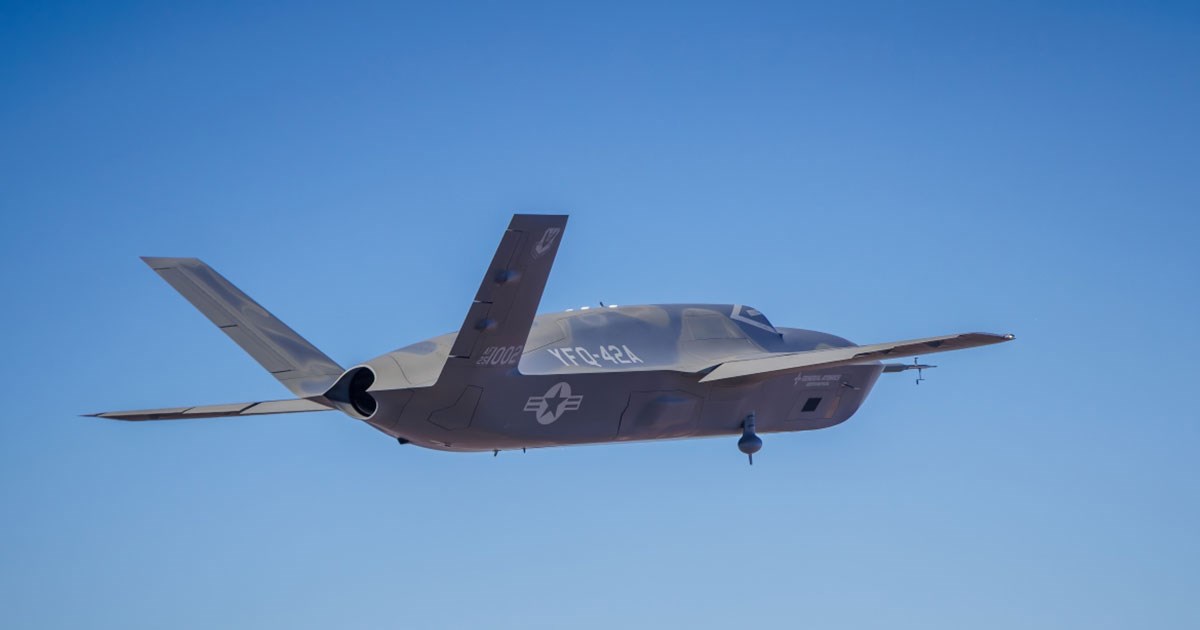
The YFQ-42A Collaborative Combat Aircraft, built by General Atomics Aeronautical Systems, Inc. (GA-ASI) for the U.S. Air Force, has returned to flight testing following a series of safety reviews and software enhancements for the new uncrewed fighter jet.
The return follows a strategic pause in flight testing stemming from an April 6 mishap shortly after takeoff. Other aspects of the YFQ-42A program, including ground testing and other Technology Maturation and Risk Reduction (TMRR) activities, continued without interruption. No personnel were injured in the incident, although the aircraft was a total loss. A thorough safety review isolated the cause to an autopilot miscalculation of the aircraft’s weight and center of gravity, prompting a software remediation.
The Air Force and GA-ASI conducted a joint review following the mishap. After a stringent evaluation, technical authorities endorsed the software changes, and the YFQ-42A has returned to the air.
David R. Alexander, President of GA-ASI, stated:
“We are excited to have the YFQ-42A flying again. It has been said that you learn more from your setbacks than your successes. We are applying what we have learned to our growing fleet of CCAs as we continue building the most dependable and cost-efficient unmanned fighters in the world.”
The YFQ-42A is a purpose-built CCA platform developed as part of ongoing investment in next-generation semi-autonomous combat aircraft. The aircraft’s modular design enables rapid integration of mission systems and mission autonomy software. GA-ASI’s software architecture, demonstrated through multiple live flight tests on various airframes, provides the foundation for human-machine teaming in complex combat scenarios.
GA-ASI was selected by the U.S. Air Force in April 2024 to build production-representative flight test articles for the CCA program. The YFQ-42A successfully conducted its maiden flight in August 2025, validating a “genus/species” concept for rapid, modular, and low-cost uncrewed fighter aircraft development. This approach enables a common core aircraft design that can be rapidly adapted for different mission sets and service requirements.
