

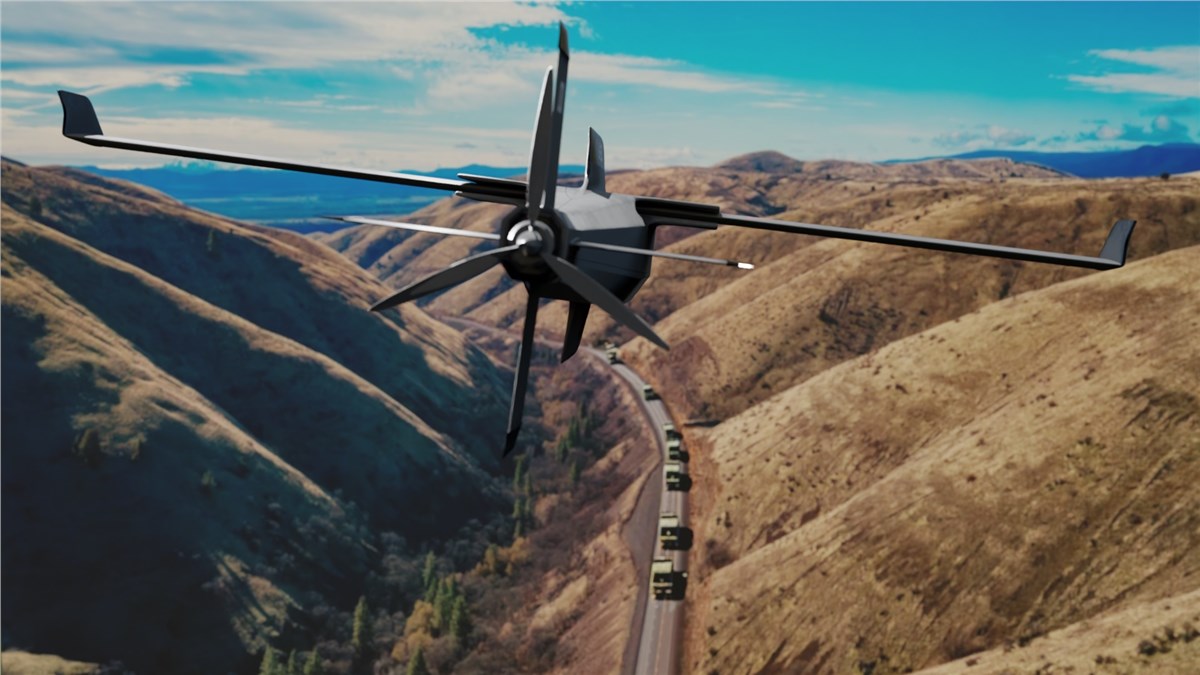
Rheinmetall has successfully demonstrated its new FV-014 loitering munition system to a potential NATO customer. The demonstration took place on 18 February 2026 at the National Test Centre for Unmanned Aerial Systems of the German Aerospace Centre (DLR) in Cochstedt, Saxony-Anhalt. During the demonstration, the FV-014 simulated various mission scenarios and attack flights. For Rheinmetall, the successful test marks another milestone in its loitering munition activities.
Rheinmetall’s state-of-the-art LMS FV-014 is designed for dynamic combat deployment at ranges of up to 100 kilometres. The system combines high effectiveness against armoured and soft targets with advanced sensor technology, network capability, and deployment options even in GNSS-jammed environments.
The FV-014 is designed as a true loitering munition system, combining reconnaissance and effect in a single platform. It supports tactical units in combating high-value point targets such as combat vehicles, artillery positions, or command vehicles over long distances beyond the line of sight. The system is launched from a launch container using a booster but can also be deployed from a multi-launcher. After launch, the FV-014 unfolds its folding wings and transitions to aerodynamic flight, with an operational range of up to 100 kilometres and a flight duration of 70 minutes.
The FV-014 is initially designed as a portable system for use at troop level and is controlled via a user-friendly ground station enabling permanent human-in-the-loop control. The operator can identify targets, launch a precise attack, or abort the mission if conditions change. The flight body follows a classic wing concept with electric propulsion and faceted structures to reduce signatures, enabling high approach speeds. The system is optimised for low acoustic and thermal signatures and can operate in electromagnetically demanding scenarios with disrupted satellite navigation.
