

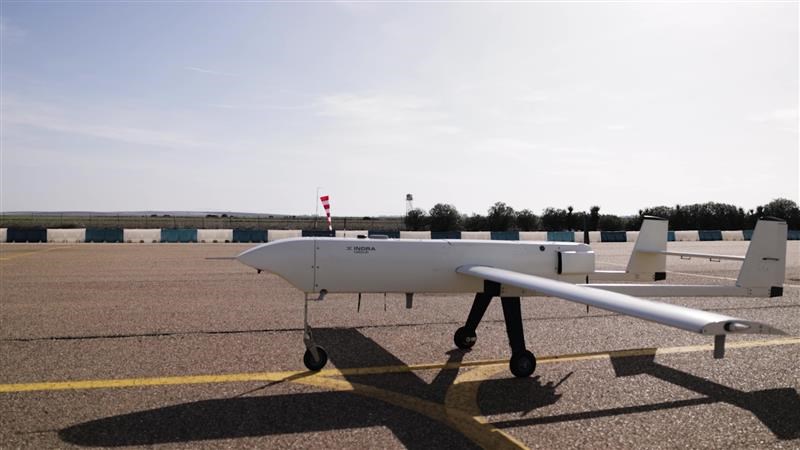
Indra has demonstrated the effectiveness of its new collision detection and avoidance system for unmanned aircraft, developed under the strategic program of the Galician Aerospace Hub in a joint venture with Tecnobit-Grupo Oesía. The company completed a series of test flights with a multirotor UAV equipped with cameras and radar, which detected an Indra TARSIS-family UAV at distances of up to one kilometer and executed optimal avoidance maneuvers.
During the exercises, typical flight profiles were recreated, with approaches using different trajectories, altitudes, and speeds. The system’s performance was verified in Unmanned Traffic Management (UTM) environment scenarios, from low-altitude flights up to 2,000 meters. This detection and avoidance capability is especially relevant for complex operations such as drone swarms and for safely integrating UAVs into airspaces shared with manned or unmanned aircraft.
Indra’s system stands out for its ability to fuse information from multiple onboard cameras covering 360 degrees, allowing discrimination of small or distant targets. These data are complemented by electronically steered radar, essential in low-visibility conditions. Additionally, the system has high onboard processing capacity, enabling advanced algorithms that optimize decision-making.
After successfully completing tests at the Aerohíspalis airfield in Seville, the project developed by Indra and Tecnobit-Grupo Oesía has taken a decisive step forward. Both companies are working on drone-based systems for rescue operations, detection of marine spills, and forest fire extinguishing. To this end, they are developing VTOL-type UAS platforms offering great operational flexibility and equipped with hybrid propulsion (electric and combustion) to achieve extended autonomy. These drones will be able to carry payloads of up to 20 kilograms, meeting the growing demand for medium-sized UAVs in the market.
