


Editor Sagar Singamsetty in conversation with Matt McCrann, CEO, SPARC AI, USA
SPARC AI operates at the intersection of artificial intelligence, autonomy and defence. From a broader defence-industry perspective, what strategic problem is the company aiming to solve for military and security organisations?
The strategic problem we are addressing is that autonomy cannot scale without trusted positioning. It’s an enabling technology, not a feature or use case.
Every autonomous system must answer two fundamental questions: Where am I, and where is the object or point of interest I am observing? GPS has traditionally answered the first, but it is increasingly unreliable in contested environments. Answering the second often requires specialized hardware or significant operator involvement.
The Overwatch Positioning Network provides aircraft position and target geolocation without depending on GPS or requiring a proprietary navigation payload on every platform. It is designed to use data and sensors already available within the customer’s architecture.
Our objective is to turn resilient positioning from a platform-specific feature into a common infrastructure layer that can support mixed fleets. Militaries do not simply need to manufacture and field more autonomous systems. They need to scale mission capability. Trusted positioning enables those systems to navigate, understand their geospatial environment, coordinate and remain effective when conditions are contested.
GPS denial and electronic warfare are becoming increasingly important factors in modern conflicts. How do you see this changing the way defence forces approach navigation, targeting and operational resilience?
GPS denial is no longer an edge case. Defence forces have to assume GPS will be jammed, spoofed, or unreliable and design systems and operations accordingly. Right now there are two approaches widely taken, look for an custom alternative PNT solution which requires specialized hardware or AI or computer vision software on the platform system OR accept the constraints and tradeoffs that come with operating without any GNSS.
That’s the reality today. However, those are not acceptable options. Needing custom or specialized solutions for each system and platform to have positioning doesn’t scale and operating under constraints limiting mission effectiveness isn’t advantageous or sustainable. That means moving away from GPS as a single source of positional truth and toward layered positioning capabilities. Even if a drone remains airborne without GPS, if it’s unable to navigate accurately, geolocate a target, share useful information, that’s not a resilient capability. Resilience has to be measured by whether the system can continue its mission. Overwatch adds another trusted position source alongside any platform’s existing navigation systems.
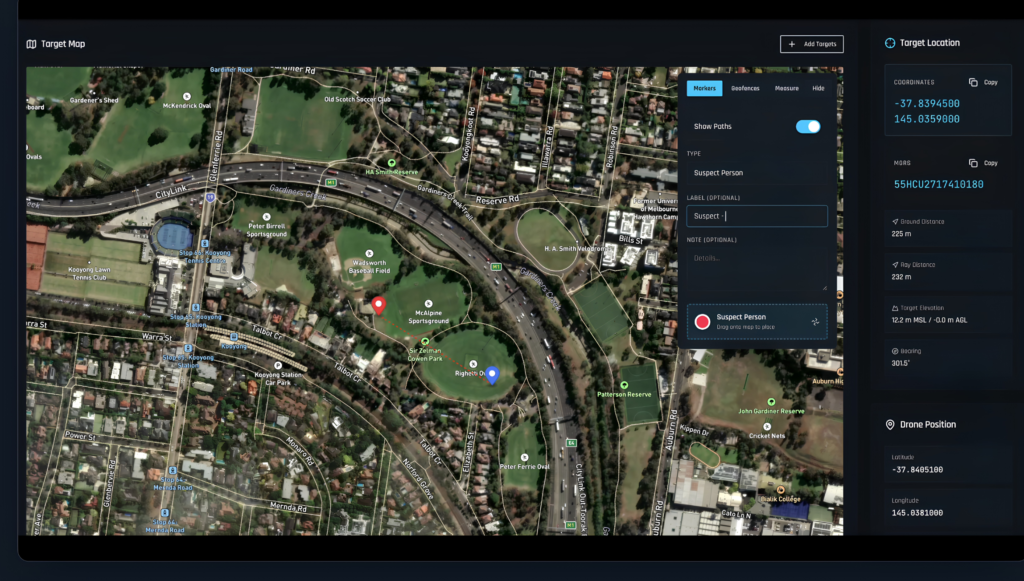
SPARC AI’s technology is software-only and hardware-agnostic. What advantages does this model offer defence organisations compared with developing capability around proprietary or platform-specific systems?
Defence organizations operate mixed fleets with different aircraft, sensors and control systems. A platform-specific solution can require new hardware and repeated integration, while adding weight, power consumption and supply-chain dependencies to every aircraft. Not just inefficient and time consuming, this easily leads to vendor lock-in.
Overwatch can operate from a data centre, within a private network, on an edge-computing platform or onboard the aircraft itself. The right configuration depends on the mission’s connectivity, security and computing constraints. It can scale to millions of simultaneously connected devices and deliver position to those systems as quickly as every 30ms.
Hardware-agnostic doesn’t mean that no integration or validation is required. But it does mean the customer is not permanently tied to one platform, sensor or supplier. A customer can leverage every platform or tool at its disposal, simultaneously while delivering accurate positioning without any GPS or physical infrastructure. With integration into Overwatch possible with new systems in less than 10 minutes, we attempt to remove much of the integration burden as well.
As militaries move towards greater use of autonomous and networked systems, what are the biggest challenges in ensuring interoperability between different platforms, sensors and command-and-control architectures?
Without interoperability, you don’t have coordination. Without coordination, you can’t have autonomy. That’s where much of the autonomy space is now. Without reliable positioning delivered across all systems and domains, we fall back to pilots and specialized hardware payloads required to operate “autonomous” systems at basically a 1:1 ratio. Resilient positioning and comms are the enabling technologies that allow for autonomy, orchestration, and real-time decision making.
Overwatch is designed to provide situational awareness across a connected fleet. How important will multi-platform coordination and collaborative autonomy become in future defence operations?
Multi-platform coordination and collaborative autonomy will be vital to future defence operations. It’s the promise of autonomy and autonomous systems are the delivery platforms. One of the key challenges in terms of delivering this will be offering position assurance at massive scale. Tomorrow’s force structure will involve mixed-platform environments and groups consisting of thousands of drones. Collaborative autonomy will continue to grow in importance along with software-defined hardware-agnostic, cost-effective positioning solutions that can be easily scaled across deployed mixed fleets. The need for ubiquitous resilient positioning will become very obvious once autonomy matures beyond specific platform and battlefield domain silos.
Australia has developed an increasingly important position in defence innovation and autonomous technologies. What lessons from the Australian defence innovation ecosystem could be relevant for European governments and industry?
Australia has had to develop capability for vast operating conditions with a lean, focused industrial base and a strong requirement to operate alongside close allies. A lot of focus for everyone now is on sovereign capability. I think an important way to look at that is that sovereign capability should mean sovereign specialization or value add and sovereign control, not sovereign isolation. When we all build sovereign capability in isolation, we end up with 40 companies building interceptors that all look the same, have little differentiation, and miss the mark for the operators we look to serve.
SPARC AI is now registered by the Australian Government as an authorized user under the AUKUS license-free environment, which allows the company to move eligible defense technology to US and UK partners without requiring a separate export permit, which is highly consequential for SPARC AI’s work with US-built drone platforms. We also work closely with leading manufacturers and subject matter experts in Ukraine. So, a sovereign defence technology company, working with the best across various regions, delivering leading capability to allies. That should be the goal for the defence innovation ecosystem, Europe and everywhere.
European defence organisations are accelerating investment in autonomous and AI-enabled capabilities. What opportunities do you see for SPARC AI to collaborate with European defence companies, system integrators and government programmes?
With European defense rearmament facing supply chain bottlenecks and long industrial lead times, there’s a key role for software-defined autonomy which can be delivered in minutes rather than via long procurement and refit cycles. Overwatch is delivered as a network with no hardware to ship, build or install. There is no integration lag, no bill of materials and no lead times. Autonomous and GPS-denied capability arrives with the speed of an API key, and can scale from one airframe to hundreds of thousands with shorter or no formal procurement cycles, which will be highly appealing to European defense organizations.
We are an enabling technology, a nearly invisible infrastructure that partners and government programmes can build best of breed navigation, autonomy, ISR, and decision making solutions on top and scale infinitely, on demand.
Looking ahead, how do you expect the relationship between human operators and autonomous systems to evolve, particularly as AI takes on a greater role in decision support and mission execution?
With AI taking an ever-greater role in decision support and mission execution, the relationship between human operators and autonomous systems will evolve beyond today’s ‘one-to-one’ or ‘one-to-few’ approaches, where autonomous operations are enabled either by either one pilot operating a drone or one specialized payload per drone. While these approaches have previously shown off the ingenuity of the drone industry and the skill of operators, they have a fundamental limitation, meaning that autonomy cannot scale effectively. By enabling true autonomy, we actually scale judgement and the impact operators and decision makers can have on the mission and the speed at which they can execute. At SPARC AI we look to provide the underlying positioning that unlocks that autonomy.
