

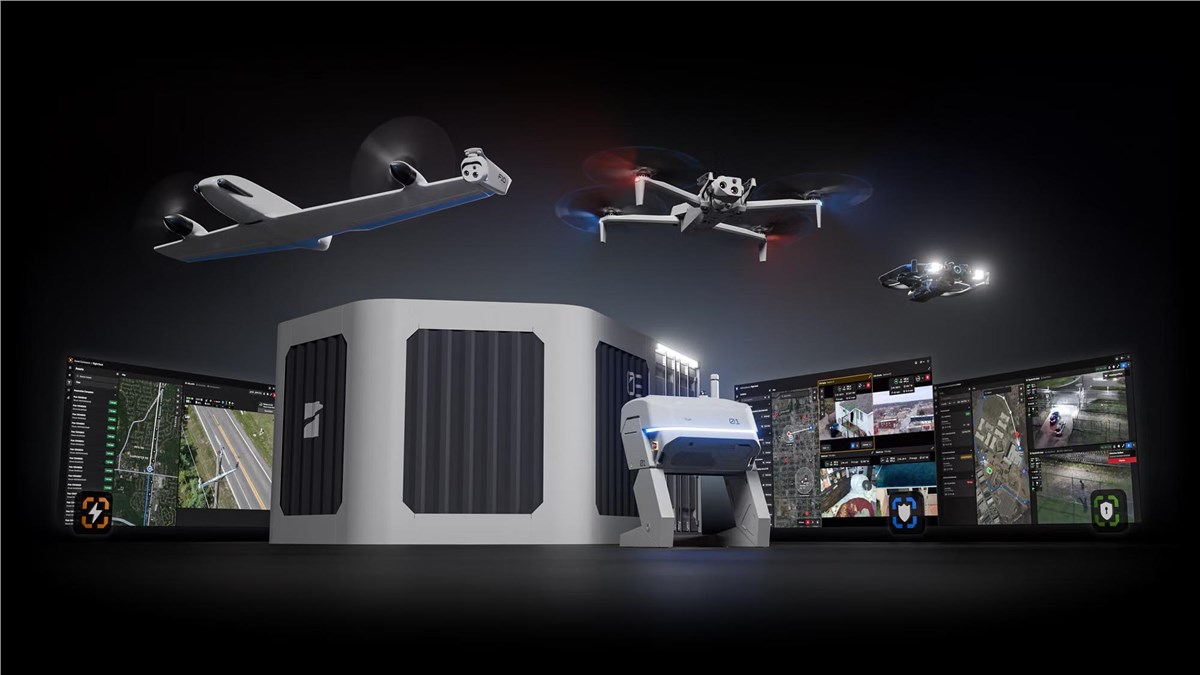
Skydio is expanding its autonomous drone ecosystem with the introduction of the F10 Lightrunner, its first fixed-wing aircraft, alongside the MegaDock automated deployment platform. The new system is designed to address longer-distance and higher-speed missions for emergency response, search and rescue, infrastructure inspection and security operations.
The F10 Lightrunner is designed to reach speeds of up to 100 mph and is scheduled to begin deploying to customers in 2027. Skydio says the aircraft can launch within seconds and provide live aerial visibility while ground teams are still travelling to an incident.
A key feature is the aircraft’s SideEye camera configuration, which positions the camera outside the rotor plane and is designed to maintain a consistent view of a subject during flight. The system is also equipped with Robotic Takeoff and Landing (RTOL), using a suction-based robotic gripper to autonomously launch and catch the aircraft.
The accompanying MegaDock can accommodate up to five F10 aircraft, enabling multiple missions to be managed from a single location. With an advertised 30-mile flight radius, Skydio says one MegaDock could provide coverage across nearly 3,000 square miles.
The F10 is designed for autonomous operation in a range of conditions, including significant wind, moderate rain and day-or-night missions. Its capabilities include an integrated parachute and Connect Fusion+, which combines multiple cellular connections to maintain command, control and live video during long-range operations.
Skydio is also extending its existing autonomy technology to the new fixed-wing platform. Pathfinder plans routes before launch using information such as terrain, structures, geofences, agency boundaries and airspace restrictions. Once airborne, Foresight continuously evaluates aircraft status, environmental conditions and obstacle information to adapt the flight path.
The company’s Skydio Airspace Assurance System (SAAS) combines real-time airspace information, organizational policies and onboard perception to support compliant flight operations. Skydio says the system can also automatically manoeuvre away from nearby crewed aircraft when necessary.
The F10 joins the company’s existing X10 and R10 platforms, which use the same underlying autonomy engine. Skydio says its customer fleet now conducts approximately two million missions annually, while Pathfinder has accumulated more than 600,000 autonomous flight miles.
Alongside the new aircraft, Skydio is introducing Asset Command and Security Command, software platforms designed to integrate autonomous drones directly into infrastructure inspection and physical security workflows.
Asset Command connects drone inspections with existing asset-management systems and inventories, while Security Command is designed to enable automated drone patrols, threat detection and rapid response across multiple locations.
Skydio is also introducing Controller 2, featuring a 7-inch display, up to 5.5 hours of runtime and an IP55 rating. The company is further upgrading its existing X10 platform with the VT300-Z Rev 2 telephoto camera and new imaging capabilities including ThermalBoost and Low-Light Enhance.
Together, the developments represent Skydio’s broader push toward autonomous drone fleets capable of operating with reduced operator intervention across public safety, infrastructure, security and other critical-industry applications.
