

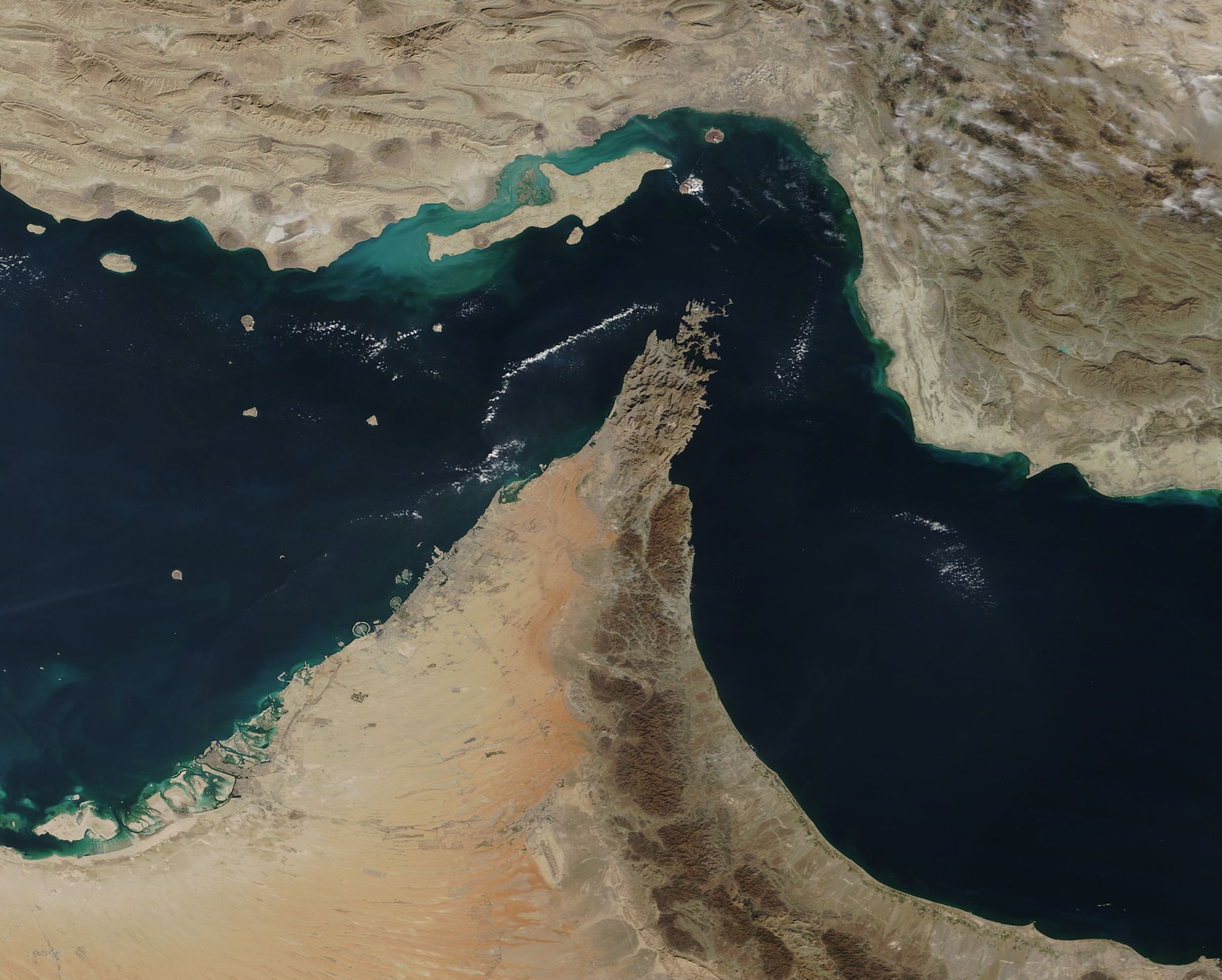
From Hormuz to the Taiwan Strait, the world’s maritime chokepoints are under unprecedented pressure. The old rules-based order is fraying and the defence sector is scrambling to respond.
The oceans have never been more turbulent. In the first five months of 2026, the Strait of Hormuz has been partially blockaded by Iran, traffic through the Red Sea’s Bab el-Mandeb remains 60 percent below 2023 levels, Chinese warships conducted their largest exercises yet around the Taiwan Strait, and the United States floated the idea of tolls on Panama Canal transits. Meanwhile, an Indonesian finance minister briefly proposed charging fees on Malacca shipping before walking the idea back under pressure. These are not isolated incidents. They are symptoms of a fundamental breakdown in the maritime order that has underpinned global trade for seventy years.
More than 80 percent of world trade moves by sea. With around 200 navigable straits and chokepoints on the global chart, a handful of narrow passages carry disproportionate weight: block one, and the shockwaves reach consumers, energy markets, and defence ministries from Brussels to Canberra within days. The question policymakers can no longer defer is simple and alarming: who will control and defend these straits going forward?
A world of chokepoints under siege
The Strait of Hormuz is the most acute crisis point. Over 21 million barrels of oil pass through its 55-kilometre narrows every day, roughly 21 percent of global petroleum consumption. Since the United States and Israel launched military operations against Iran in late February 2026, Iran has intermittently attacked commercial vessels, imposed de facto ‘permissioning’ on transits, and deployed its Islamic Revolutionary Guard Corps Navy’s fleet of fast-attack craft, coastal missile batteries, and mining capabilities. The result has been a sustained energy price shock and a near-total re-evaluation of Gulf shipping risk.
Proposals for a regional ‘Congress for Hormuz’ modelled on the Montreux Convention that governs Turkey’s Bosphorus have gained traction among Gulf Cooperation Council states. Unlike the Bosphorus, Hormuz has no dedicated treaty framework, a legal vacuum that has made it uniquely vulnerable to great-power impositions. Codifying a regional security architecture would be a diplomatic breakthrough; whether it is achievable while the conflict continues is another matter.
In the Red Sea, the story is one of durable disruption. Despite a partial ceasefire in 2025, Suez Canal traffic remained roughly 60 percent below pre-crisis baselines as of early 2026. Shipping companies that reorganised their logistics around the Cape of Good Hope route have shown organisational inertia: reversing the decision requires sustained confidence that threats are permanently eliminated, not merely paused. The additional 6,000 to 11,000 nautical miles per Asia-Europe voyage has added an estimated $15 to $20 billion annually to global supply chain costs and contributed 0.3 to 0.5 percentage points to global inflation.
“We have not seen the oceans this turbulent and dangerous.” — Elisabeth Braw, Atlantic Council
In East Asia, the Taiwan Strait has become the centrepiece of a different kind of pressure. China conducted its largest strait exercises in April 2025, and a Chinese aircraft carrier made its first strait transit of 2026 in April. Beijing claims sovereignty over the Taiwan Strait waters; the West insists on freedom of navigation. European navies, i.e., British, French, and German vessels among them, have increased freedom-of-navigation transits through the strait, partly to safeguard semiconductor supply chains: over 60 percent of the world’s advanced chips are manufactured in Taiwan. Xi Jinping’s reported 2027 military-readiness deadline for a potential Taiwan contingency concentrates minds further.
Elsewhere, structural stresses compound the political ones. The Panama Canal relies on Gatun Lake’s freshwater reserves for its lock system. Repeated El Niño-linked droughts have forced restrictions on vessel size and daily transits, raising freight costs and prompting rerouting and President Trump’s commentary about US ‘rights’ over the canal has added a political dimension to a climate-driven logistical crisis. The GIUK (Greenland-Iceland-United Kingdom) gap, long a Cold War obsession, has re-emerged in NATO planning as Russian submarine activity in the North Atlantic has intensified.
What the major powers are saying and spending
The United States 2025 National Security Strategy is, at its core, a maritime document. It echoes Alfred Thayer Mahan’s thesis that sea power equals national power, and tasks the Navy with keeping Hormuz and the Red Sea open, deterring China in the First Island Chain, and securing the Western Hemisphere simultaneously. The FY2027 defence budget proposes a historic $1.15 trillion in discretionary spending, including the largest naval shipbuilding order since Franklin Roosevelt: 41 ships, an expanded Columbia- and Virginia-class submarine programme, and initial funding for a new battleship. The stated aim is to grow the fleet from roughly 300 ships to 350 or more.
“Europe can no longer be a custodian for the old world order, for a world that has gone and will not return.” — Ursula von der Leyen, President of the European Commission, March 2026
The European Union’s response has been more measured but increasingly urgent and the language from Brussels has sharpened markedly. Addressing EU ambassadors in March 2026, Commission President Ursula von der Leyen declared that “Europe can no longer be a custodian for the old world order, for a world that has gone and will not return.” High Representative Kaja Kallas was more direct still on the operational question: “It is in our interest to keep the Strait of Hormuz open,” she told reporters ahead of an emergency meeting of EU foreign ministers, as she explored whether the mandate of the EU’s Aspides naval mission could be expanded to escort commercial vessels through the strait. The EU Maritime Security Strategy identifies Hormuz, Bab el-Mandeb, Malacca, and the South China Sea as direct threats to European prosperity, and the European Council has called for both ASPIDES and Operation Atalanta to be reinforced with additional assets. A joint statement endorsed by 36 countries in March 2026 condemned Iran’s de facto Hormuz closure and reaffirmed freedom of navigation as a fundamental principle of international law.
In Asia, Australia’s April 2026 National Defence Strategy commits up to $399 billion US dollars over a decade toward AUKUS submarine capabilities, long-range weapons, and autonomous maritime systems. Japan has embarked on its most significant defence buildup since the Second World War, adding long-range strike options and naval air defence. China, meanwhile, invests at scale in naval expansion, coastal missile systems, and grey-zone capabilities, while its ‘string of pearls’ port-access strategy from Djibouti to Gwadar provides logistical depth for growing blue-water ambitions. The International Maritime Organization’s Secretary-General has called for AI-driven surveillance and satellite monitoring systems to anticipate and deter threats, and flagged that the move toward autonomous vessels makes cybersecurity governance an urgent priority.
India’s voice in this debate carries particular weight and particular urgency. Some 95 percent of India’s trade by volume and 70 percent by value transits through the Indian Ocean Region, with approximately 30 percent of its crude imports and 55 percent of its LNG imports passing through the Strait of Hormuz alone. The crisis became personal in April 2026 when two Indian-flagged vessels were fired upon by Iranian Revolutionary Guard gunboats near Larak Island and forced to turn back, despite Tehran’s prior assurances of safe passage. Prime Minister Narendra Modi had already made New Delhi’s position plain: “attacks on commercial ships and the disruption of international waterways like the Strait of Hormuz are unacceptable.” In a call with Iran’s president in March 2026, Modi pressed the point further, condemning attacks on infrastructure affecting global supply chains and insisting on freedom of navigation as non-negotiable. External Affairs Minister S. Jaishankar has framed the strategic response in broader terms, calling on Indian Ocean Region nations to build greater collective resilience through trusted partnerships, a pointed alternative to the unilateral power plays now reshaping the straits. India’s expanding tri-service Andaman and Nicobar Command, positioned astride the Strait of Malacca, and its SAGAR vision of the Indian Ocean as a shared commons are the practical expression of that ambition.
What this means for the defence sector
Global defence spending reached $2.63 trillion in 2025 and the trajectory points sharply higher. For the maritime defence sector specifically, the implications are transformative. The undersea defence infrastructure and security market is projected to reach $56.75 billion by 2036, expanding at a 6.8 percent compound annual growth rate, as naval forces prioritise persistent underwater monitoring and protection of energy pipelines and subsea data cables.
Anti-ship missile defence is surging. The cost gap between cheap attack drones, Iran demonstrated that $20,000 platforms can impose major costs on global shipping and legacy intercept systems have become a strategic liability. Investment in missile defence is projected to grow from $55.7 billion to $98.5 billion over the next decade. The UK’s DragonFire directed-energy laser programme, Thales’ AI-enabled mine-hunting systems for the Royal Navy, and the Anduril-Ultra Maritime collaboration on autonomous underwater vehicles all point toward a defence industry pivoting from platform-centric to network-centric maritime security. For European primes and their supply chains, this is both a market opportunity and an industrial urgency.
Yet access to capital remains constrained. Smaller defence suppliers still report difficulty navigating ESG restrictions and bank reluctance to finance defence activities, even as governments identify this gap as an existential risk to their programme timelines. A UK task force co-chaired by the Defence Secretary and Chancellor has called for a comprehensive 10-year investment strategy to attract private capital. The problem is structural and Europe-wide.
The bottom line
The straits of the world have always been contested. What is new is the simultaneity and the structural depth of today’s crises: a hot conflict at Hormuz, durable disruption in the Red Sea, a slow-motion showdown in the Taiwan Strait, climate stress at Panama, and a resurgent submarine threat in the North Atlantic, all at once and all with direct consequences for European prosperity and security.
The old answer that the US Navy would keep the sea lanes open, that UNCLOS provided the legal framework, and that trade would flow is no longer sufficient on its own. Meeting this moment requires European navies and Indo-Pacific partners to step up, to invest in autonomous systems and AI-enabled surveillance, and to build legal architecture for today’s threats. It requires the defence industry to scale at a pace it has not managed since the Cold War.
The straits of the world have always been contested by those who understand that commerce, energy, and military reach all flow through the same narrow waters. What distinguishes this moment is not the ambition of the powerful, that is eternal, but the fragility of the frameworks designed to contain it. Collective policy, sustained dialogue, and binding international regulation are not idealistic alternatives to hard power. They are, historically, the only things that have actually worked.
Who controls the straits controls the world. But history’s most durable answer to that question has never been unilateral dominance, it has been collective frameworks, codified in treaty, enforced through multilateral presence, and sustained by diplomatic investment. The Montreux Convention has kept the Bosphorus open for ninety years. The absence of any equivalent architecture for Hormuz, Malacca, or the South China Sea is not an accident, it is the vacuum that great powers now rush to fill. The task for European policymakers, Indo-Pacific partners, and international institutions is not to out-muscle China or Iran at sea. It is to build the legal, diplomatic, and institutional scaffolding that makes dominance irrelevant before the next crisis makes it impossible.
Write for EDI | Advertise with EDI
European Defence Insights welcomes op-eds and analytical contributions from defence professionals, policymakers, academics, and industry leaders across Europe and beyond. If you have a perspective on European security, defence policy, or the global defence industry, we want to hear from you. We also offer advertising and partnership opportunities for organisations operating in the aviation, defence and space sectors.
Send your submissions and advertising enquiries to: info@europeandefenceinsights.com