

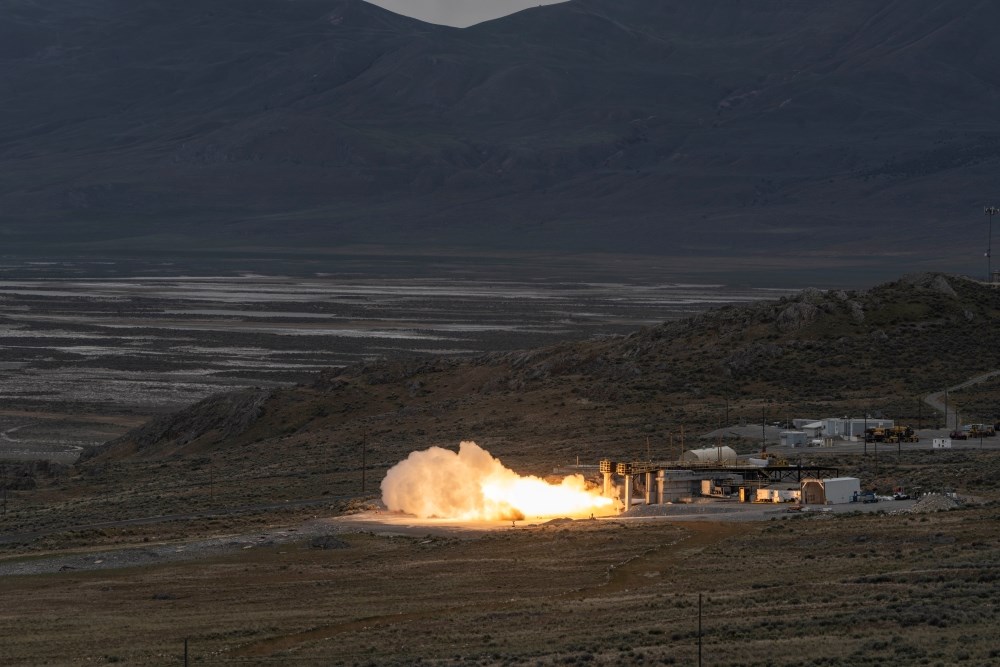
Over the past five months, Northrop Grumman put its engineering excellence on display, executing on three company-funded static tests, proving high-performance, affordable motors can be conceived, built and validated in under a year.
Driving Innovation at the Edge of Physics
Solid rocket propulsion operates at the edge of physics and turns extreme technical complexity into dependable performance, from deep-space to national defense missions. The motors used in all three events, in under one year, demonstrate the company’s ability to push the boundaries of power, affordability, and innovation.
The most recent static test used a Northrop Grumman large solid rocket motor as a test bed demonstrating design improvements, analytical models, and a new propellant that will enhance our current and future solid rocket motors across our portfolio. Northrop Grumman’s propulsion teams use advanced manufacturing, new materials and analytics to build rockets that power both defense missions and deep-space projects.
“We see solid-rocket propulsion as a driver of the future—using disciplined testing and rapid manufacturing cycles for both defense and deep-space missions. These critical tests set a new industry standard, giving our customers confidence in every mission,” said Jim Kalberer, the company’s vice president of propulsion systems.
Driving Cost-Effective, High-Performance Solid Rocket Motors
A new propellant used in recent demo solid-rocket tests packs the same or more energy as today’s fuels in a lower-cost formulation and can power new space-launch or hypersonic rockets. The propellant can be manufactured across multiple sites, providing common performance and meeting increased demand across multiple applications. When rocket performance is more consistent, it expands the types of missions it can handle, boosting reliability and allows the company to produce larger numbers of solid-rocket motors for launch vehicles.
Alongside material advancements, the company is pushing large solid-rocket motors forward by using updated designs, new material-making processes and advanced computer models. These models accurately predict how hot gases, heat, material behavior and surface wear will act, letting engineers finetune performance and durability.
The team then rigorously tests the models to make sure they consistently forecast ballistic, mechanical and structural results—showing the company’s dedication to engineering excellence, cost-effective reliability and high-performance propulsion.
“Our latest breakthroughs aren’t just about making solid rocket motors better—they’re about redefining what’s possible. Faster production, smarter design and cost-saving innovations mean we’re delivering cost-effective, unstoppable propulsion power for today’s toughest missions,” said Kalberer.
Category Leadership and Future Commitment
As the propulsion foundation of critical space and defense programs, Northrop Grumman embraces its responsibility to engineer with precision and test with discipline. The company’s SMART Demo program—now in its third year—has driven advances in solid rocket motor technology, delivering new capabilities that reduce development time and cost without sacrificing performance.
Over the past seven years the company has invested more than $1 billion to expand and modernize its Utah facilities, a strategic effort that meet growing customer demand and achieve the goal of doubling production capacity before 2030. These investments enable the company to deliver proven solid rocket motors at scale today, while expanding operations and production capacity across its propulsion portfolio to meet rapidly increasing demand.