

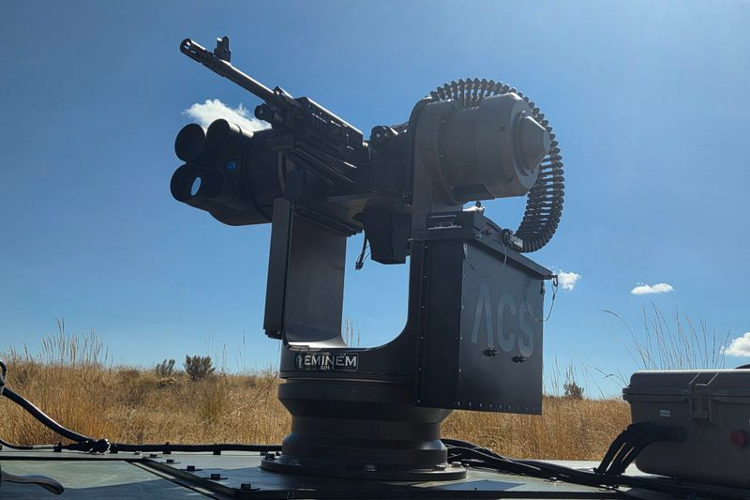
Allen Control Systems is expanding its operational footprint in Austin, Texas, to accelerate production of its flagship Bullfrog autonomous counter-UAS system, responding to growing military demand for advanced counter-drone capabilities.
The company has significantly increased the size of its Austin facility, enabling enhanced low-rate initial production, expanded research and development activities, and integrated testing and evaluation. The upgraded infrastructure is designed to support faster delivery timelines to U.S. and allied defense customers as counter-drone requirements continue to intensify globally.
Bullfrog is an AI-enabled autonomous weapon station engineered to transform conventional or modern weapon platforms into highly precise counter-drone systems. By integrating artificial intelligence, computer vision, and proprietary fire-control software, the system can automatically detect, track, and engage hostile unmanned aerial systems with minimal human intervention. This capability is particularly critical in countering fast-moving or swarm-based drone threats that can overwhelm traditional defense setups.
Company leadership has emphasized that the expansion is a strategic move to keep pace with evolving battlefield realities. Small unmanned systems have become a persistent threat across conflict zones, driving urgent demand for scalable, adaptable, and rapidly deployable counter-UAS solutions. As adversaries increasingly leverage commercially available drones for surveillance and attack roles, autonomous defensive systems are becoming central to force protection strategies.
The Austin expansion will also support workforce growth, with additional engineering, manufacturing, and systems integration roles expected to be created. By strengthening domestic production capacity, the company aims to ensure supply chain resilience while delivering high-performance counter-drone systems at speed. The move reflects a broader industry shift toward AI-driven autonomy in defense platforms, where layered airspace protection architectures combine detection, tracking, and neutralization in a single integrated framework.
